SOC Analyst Training in Hyderabad
with Splunk, Sentinel and Real Alert Investigation
SOC Analyst training in Hyderabad at Cyber Security Academy is three months of instructor-led training in security monitoring and investigation — SIEM, log analysis, alert triage, endpoint investigation, phishing analysis and incident response. Fourteen modules across Splunk, Microsoft Sentinel and QRadar, with nine real investigation projects, delivered as classroom batches in Kukatpally or live online.

Course snapshot
 Duration
3 months
Duration
3 months
 Mode
Classroom + live online
Mode
Classroom + live online
 Modules
14 modules, 18 tools
Modules
14 modules, 18 tools
 Level
Freshers to L2 analysts
Level
Freshers to L2 analysts
 Next batch
2 November 2026
Next batch
2 November 2026
 Location
Kukatpally, Hyderabad
Location
Kukatpally, Hyderabad
SOC Analyst Training in Hyderabad — Quick Facts
Everything a prospective learner asks a counsellor in the first two minutes.
Course
SOC Analyst Training in Hyderabad
Location
Kukatpally, Hyderabad
Training mode
Classroom + live online + recorded
Duration
3 months
Classroom fee
₹32,000
Online fee
₹25,000
Recorded course
₹9,999, lifetime access
Curriculum
14 modules, 18 tools, 9 investigation projects
Key areas
SIEM, alert triage, EDR, phishing, threat intel, IR
Certification prep
Security+, Microsoft SC-200, Splunk pathways
Next batch
2 November 2026
Prerequisites
Basic computer knowledge. Networking taught from scratch.
Placement support and career outcomes
What we do, stated plainly, and what we do not claim.
Resume and portfolio review
Your CV is rebuilt around the nine investigations you actually documented, using the terms SOC hiring managers screen for.
SOC scenario interviews
Technical rounds on SIEM, logs and triage, plus the scenario round every SOC interview uses: here is an alert, what do you check first?
Job-role selection
SOC L1, SIEM engineering and detection engineering are different paths. We help you pick the one that fits how you work.
LinkedIn profile setup
Headline, skills, certifications and project section, so recruiter search surfaces you for SOC roles.
Internship certificate
The classroom programme includes an internship certificate based on your completed capstone project work.
What we don't promise
No job guarantee, no guaranteed salary, no placement percentage. Any institute quoting those numbers cannot evidence them either.
Companies hiring SOC analysts in Hyderabad
MNCs, global capability centres, managed security providers and consulting firms running security operations from Hyderabad. We prepare you for their interview process. We are not claiming a hiring partnership with them.
Why choose this SOC Analyst training in Hyderabad
Every reason below is something you can verify before you pay.
Our SOC Analyst training in Hyderabad follows the path an analyst actually takes: computer and networking basics, then Windows, Linux and Active Directory, then SIEM, then alert triage and investigation. You search real sample security events rather than reading definitions.
Fourteen modules cover Splunk with SPL, Microsoft Sentinel with KQL, QRadar, endpoint investigation with Sysmon and Defender XDR, phishing analysis, threat intelligence, MITRE ATT&CK, incident response and detection engineering.
It finishes with nine investigation projects — failed logins, brute force, phishing, suspicious PowerShell, malware, network traffic, account compromise, a SIEM detection build and an ATT&CK mapping exercise.
Book a free demo class
See a real session before you commit — no obligation.
Three SIEMs, not one
Splunk, Microsoft Sentinel and QRadar. Job descriptions name different tools, so we cover the three you will actually meet.
Alert triage drilled, not described
The ten-step triage process, run repeatedly against real sample events until it is automatic.
You search real events
Not slides about SIEM. You write SPL and KQL against sample security data from the first SIEM module.
Twelve log types
Windows, Linux, authentication, AD, firewall, VPN, DNS, proxy, web server, email, endpoint and cloud.
Networking and OS from zero
Three modules before any SOC tool, so non-technical learners are not lost in week three.
Endpoint investigation in depth
Sysmon, process trees, command lines and Defender XDR. Where most confirmed incidents are proven.
Phishing investigated end to end
Headers, URLs, attachments and IOCs — the most common real task in an entry-level SOC.
MITRE ATT&CK mapping
Map observed activity to techniques and find detection gaps, the way a real blue team does.
Detection engineering included
Writing and tuning detections is what moves an analyst from L1 to L2. It is a module, not a footnote.
Nine investigation projects
Each one ends in written investigation notes — the actual deliverable of a SOC shift.
Classroom option in Kukatpally
In-person batches at our Nizampet X Roads centre, plus live online for everyone else.
EMI and instalment options
Classroom and online fees can be paid in EMI or two instalments.

SOC Analyst Course Syllabus — 14 Modules
Fourteen modules that follow the path from computer basics to a job-ready L1 analyst — the topics, the lab and the outcome for each one.
Cyber Security Fundamentals for SOC
Why security teams exist and what they are accountable for.
You will cover
✓ Threats and risk
✓ Attack types
✓ Security controls
✓ SOC vocabulary
Outcome: you can describe an attack the way a SOC team writes it up.
Networking Fundamentals for SOC
You cannot investigate traffic you cannot read.
You will cover
✓ IP addressing
✓ Ports and protocols
✓ DNS and DHCP
✓ TCP/IP behaviour
Lab: read live traffic in Wireshark and identify what is normal.
Windows, Linux and Active Directory
The three environments almost every alert comes from.
You will cover
✓ Windows users and permissions
✓ Linux command line
✓ Active Directory
✓ Event logging
Lab: trace a logon event across Windows and AD logs.
Security Operations Centre Fundamentals
How a real SOC is staffed, escalated and run.
You will cover
✓ People, process, technology
✓ L1, L2 and L3
✓ Shift handover
✓ Ticketing and SLAs
Outcome: you know what a Tier 1 analyst does hour by hour.
SIEM Fundamentals
The system every SOC is built around.
You will cover
✓ SIEM architecture
✓ Log sources and ingestion
✓ Parsing and normalisation
✓ Correlation rules
Outcome: the single most-hired skill on this syllabus.
Splunk for SOC Analysts
The SIEM named in the most Hyderabad job descriptions.
You will cover
✓ Splunk architecture
✓ Indexes and sourcetypes
✓ SPL search language
✓ Dashboards and alerts
Lab: write SPL searches against real sample security events.
Microsoft Sentinel, Defender XDR and KQL
Cloud-native SOC, and where SC-200 sits.
You will cover
✓ Sentinel workspaces
✓ KQL queries
✓ Defender XDR
✓ Cloud monitoring
Lab: hunt across Sentinel with KQL. Aligns with SC-200.
QRadar and Enterprise SIEM
The third SIEM you will meet in Indian enterprise SOCs.
You will cover
✓ QRadar dashboard
✓ Events and flows
✓ Log sources
✓ Offences
Outcome: you can work in any of the three major SIEMs.
Log Analysis and Alert Triage
The core daily work of the job.
You will cover
✓ Windows and Linux logs
✓ Firewall, VPN, DNS, proxy
✓ Authentication logs
✓ Severity decisions
Lab: the ten-step triage process, run against real alerts.
Endpoint Security, EDR and XDR
What is happening on the machine itself.
You will cover
✓ Antivirus vs EDR
✓ Processes and command lines
✓ Sysmon
✓ Isolation and containment
Tools: Sysmon, Defender XDR, Wazuh, Osquery.
Phishing and Email Security Investigation
The most common real task in an entry-level SOC.
You will cover
✓ Header analysis
✓ URL and attachment analysis
✓ Indicators of compromise
✓ User reporting workflow
Lab: a complete phishing investigation with IOC extraction.
Threat Intelligence and MITRE ATT&CK
Turning outside knowledge into detections.
You will cover
✓ Threat actors
✓ Indicators of compromise
✓ ATT&CK tactics and techniques
✓ Detection mapping
Tools: VirusTotal, MISP, OpenCTI, MITRE ATT&CK.
Incident Response
What happens after you confirm the alert is real.
You will cover
✓ IR lifecycle
✓ Containment
✓ Eradication and recovery
✓ Documentation
Outcome: you can hand an incident over cleanly, which is what L2 checks.
Threat Hunting, Detection Engineering and SOC Automation
Where an L1 analyst becomes an L2.
You will cover
✓ Hypothesis-driven hunting
✓ Writing detections
✓ Tuning false positives
✓ SOAR and automation
Outcome: the skills that move you up a tier.
SOC tools you will use
Each tool, what it does, and where it shows up in the labs and projects.
SOC Analyst skills you will learn
Twelve concrete capabilities you walk out with, aligned to what SOC hiring managers screen for.
Alert triage
Reading an alert, checking the user, host, time and related events, then deciding severity.
SIEM search
Writing SPL and KQL queries to pull the events an investigation needs.
Splunk
Indexes, sourcetypes, searches, dashboards and alerting.
Microsoft Sentinel
Cloud SIEM, KQL hunting and Defender XDR integration.
Log analysis
Windows, Linux, authentication, firewall, VPN, DNS, proxy and cloud logs.
Phishing investigation
Headers, URLs, attachments and indicators, end to end.
Endpoint investigation
Processes, command lines, parent-child chains and file activity.
Threat intelligence
IOCs, feeds and enrichment, turned into usable detection.
MITRE ATT&CK
Mapping observed activity to techniques and spotting coverage gaps.
Incident response
Containment, eradication, recovery and clean documentation.
Detection engineering
Writing and tuning detections, and reducing false positives.
Investigation notes
Writing up what you found so an L2 can act on it. This is what gets you promoted.
SOC investigation projects you will complete
Nine investigations, run against real sample security events. Each one ends in written investigation notes, which is the actual deliverable of the job.
Failed login investigation
Brute-force alert investigation
Phishing email investigation
Suspicious PowerShell investigation
Malware alert investigation
Suspicious network traffic investigation
Compromised account investigation
SIEM detection project
MITRE ATT&CK mapping project
Who can join this SOC Analyst training?
Suitable for a wide range of learners. No prior security experience is required to start.
Freshers and students
Start from computer and networking basics. No prior security experience needed.
IT support engineers
Ticket handling and troubleshooting transfer directly into alert triage.
Network engineers
You already read traffic. Learn to read it as an investigator.
System administrators
Windows, Linux and AD knowledge is exactly what SOC investigations use.
Non-IT graduates
SOC L1 hires from outside computer science regularly, on practical evidence.
Testers and QA engineers
Methodical investigation habits map well onto triage work.
Career switchers
A structured path from a non-security background into a night-shift-ready SOC role.
Future SOC analysts
Ready to move from IT support or study into a shift-ready L1 analyst role? This is the standard on-ramp.
SIEM · Triage · EDR · Incident responseWhich certification suits a SOC Analyst?
Certifications help. Practical evidence helps more. Here is the sequence that fits a SOC career.
CompTIA SY0-701

Microsoft Security Operations Analyst
You do not need every certification. Choose based on your experience, your target job, the tools your target employers actually run, and your budget. A candidate with nine documented investigations and Security+ will usually beat a candidate with four certificates and no evidence. Certification names, rules and fees change, so check with the provider before booking.
Certification path we prepare you for
What you receive on completion
On completing the programme you receive a Cyber Security Academy course completion certificate — a record of the modules you finished and the investigations you documented. It is separate from any vendor certification, which is issued by the certifying body.
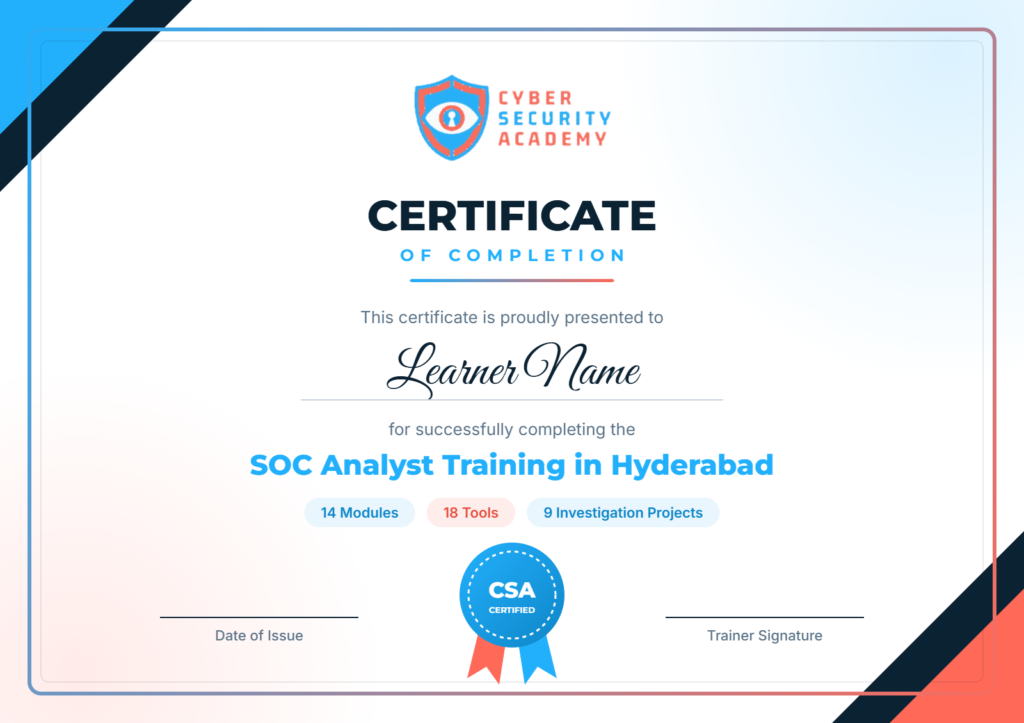 Sample · course completion certificate
Your trainer
 Lead Trainer
Mr. Praveen K
Lead trainer, security operations and threat detection.
10+ years of industry experience, teaching SIEM, alert triage, endpoint investigation and incident response from the perspective of someone who has worked real alert queues rather than only studied them.
Specialisations
Splunk, Microsoft Sentinel, QRadar, alert triage, endpoint investigation, threat intelligence and incident response.
Teaching approach
Every concept lands in a lab the same session. No module ends without an investigation actually run.
Mentorship
1:1 career mentorship and guidance on which certification path fits your background and budget.
Support
Doubt-clearing sessions, technical support and WhatsApp learning support between classes.
Learning modes and upcoming batches
Three ways to take the same 14-module syllabus.
Recorded course
Lifetime access ₹9,999✓ Fundamentals to advanced modules
✓ 1 capstone project included
✓ Tools walkthrough and certification guidance
✓ WhatsApp learning support
Classroom
Starts 2 November 2026 ₹32,000✓ 3 months, instructor-led practical training
✓ 9 investigation projects, 18 tools
✓ 24/7 lab access
✓ Internship certificate and placement assistance
Live online
Weekday and weekend ₹25,000✓ Live interactive classes, same trainer
✓ Daily recordings and LMS access
✓ Hands-on labs and real projects
✓ Placement assistance and mock interviews
EMI and two-instalment payment options are available on classroom and online training.
Check us out before you enrol
We would rather you verify everything than take our word for it. Here is exactly how.
Sit in on a live class
Book a free demo and watch an actual session — the trainer, the pace, the lab setup and the batch you would join. Nothing is staged for visitors.
Read our Google reviews
Open our Google Business Profile and read what learners wrote there. Google reviews are tied to real accounts, which is why we point you to them rather than printing quotes here.
Read reviews on GoogleAsk to see investigation notes
Ask what a finished alert investigation write-up looks like. In a SOC the notes are the deliverable. If an institute cannot show you one, the projects are a line on a brochure.
Ask about lab access
Ask how many hours a day you can reach the lab and on whose infrastructure. Hands-on time is the difference between a certificate and a skill.
Ask which SIEM you will touch
Ask whether you search real sample events or watch a demonstration. Hands-on SIEM time is the whole difference.
Compare the syllabus
Our full 14-module syllabus is on this page. Compare it module by module — particularly on Sentinel, KQL and detection engineering, which most syllabuses skip.
SOC Analyst salary in Hyderabad
Indicative market ranges by role and level. These are estimates, not offers.
Indicative annual range. Freshers, 0–2 years.
Indicative annual range. Mid-level, 3–5 years.
Indicative annual range. Freshers to mid-level.
Indicative annual range. Mid-level, 3–5 years.
Indicative annual range. Mid-level, 3–5 years.
Indicative annual range. Experienced, 5+ years.
Disclaimer. Salary figures shown are indicative market estimates and are not a guarantee of earnings. Actual compensation depends on experience, skills, certifications, employer and interview performance.
Career opportunities after SOC Analyst training
The roles this syllabus maps to, and what each one is actually accountable for.
SOC Analyst L1
Monitors and triages alerts on shift. Key skills: SIEM, log analysis, triage, ticketing.
SOC Analyst L2
Performs deeper investigation and incident analysis. Key skills: EDR, IR, threat intel, advanced SIEM.
SOC Analyst L3
Threat hunting and complex investigations. Key skills: hunting, detection, attack analysis.
Security Operations Analyst
Monitors security systems and investigates threats. Key skills: SIEM, triage, playbooks.
SIEM Analyst
Works with SIEM searches, alerts and dashboards. Key skills: SPL, KQL, correlation.
SIEM Engineer
Configures and maintains SIEM environments. Key skills: log sources, parsing, integrations.
Detection Engineer
Builds and improves security detections. Key skills: rule writing, tuning, ATT&CK.
Incident Response Analyst
Investigates and contains confirmed incidents. Key skills: IR lifecycle, forensics.
Threat Intelligence Analyst
Studies threat information and enriches detections. Key skills: IOCs, feeds, reporting.
Threat Hunter
Proactively searches for what the alerts missed. Key skills: hypothesis hunting, EDR.
Endpoint Security Analyst
Investigates endpoint threats. Key skills: Sysmon, EDR, process analysis.
Blue Team Analyst
Defends systems against live attack. Key skills: detection, response, hardening.
SOC Analyst roadmap: beginner to job-ready
The order matters. Starting on exploitation tools before networking is the most common reason learners stall.
Foundations
Computer, network and operating system basics. Taught before any SOC tool.
• Security fundamentals
• Networking
• Windows, Linux, AD
SOC and SIEM
How a SOC runs, and the system it runs on.
• SOC fundamentals
• SIEM concepts
• Splunk, Sentinel, QRadar
Logs and triage
The core daily work. Twelve log types and the ten-step triage process.
• Log analysis
• Alert triage
• Severity decisions
Investigation
Proving whether an alert is real, and what happened next.
• Endpoint and EDR
• Phishing analysis
• Threat intel and ATT&CK
Job ready
Response, detection engineering and the interview work that turns skills into an offer.
• Incident response
• 9 investigation projects
• SOC scenario interviews
Theory-based SOC training versus practical SOC training
The difference that decides whether you can work a real alert queue on day one.
Why SOC is the strongest entry point in Hyderabad in 2026
Three things specific to this city and this year.
SOCs run around the clock
The global capability centres in Hitech City, Gachibowli and Madhapur operate 24/7 security monitoring for parent companies abroad. Shift coverage means continuous, structured L1 hiring.
It is the widest door in
Most learners want to be ethical hackers. Most open security roles are SOC. L1 is the one security job that hires freshers in volume, and it leads everywhere else.
Evidence beats certificates
SOC interviews are scenario-based: here is an alert, what do you check first? Nine documented investigations answer that question better than any certificate.
Common questions, answered directly
Is SOC a good career in 2026? Yes, if you can investigate methodically and write up what you found. The demand is for people who work alerts properly, not people who close tickets.
Can a fresher get in? Yes. SOC L1 is the standard entry point in Hyderabad and hires from outside computer science regularly, on the strength of practical evidence.
How do I start? Computer basics, networking, Windows and Linux, security basics, logs, SIEM, alert triage, investigation, then projects. In that order.
Frequently asked questions
The twenty questions counsellors are asked most often, answered plainly.
What is SOC Analyst training in Hyderabad?
It is instructor-led training in security monitoring and investigation — SIEM, log analysis, alert triage, endpoint investigation, phishing analysis, threat intelligence and incident response. Cyber Security Academy delivers it as classroom training in Kukatpally and as live online batches across 14 modules over three months.
What does a SOC Analyst actually do?
A SOC Analyst monitors security alerts in a Security Operations Centre, investigates whether an alert is normal activity, a false positive or a real threat, gathers evidence, escalates when required and writes investigation notes. It is the most common entry point into a cyber security career.
Can a fresher become a SOC Analyst?
Yes, and it is the standard route in. You do not need advanced security knowledge to start. The path runs computer basics, networking, Windows and Linux, security basics, logs, SIEM, alert triage, investigation, then projects. Practical practice matters more than theory.
What is the duration of the SOC Analyst course?
Three months. Classroom and live online batches follow the same 14-module syllabus, with weekday and weekend options so you can fit it around work.
What is the SOC Analyst course fee in Hyderabad?
Classroom training is ₹32,000, live online training is ₹25,000 and the recorded course is ₹9,999. Corporate training is quoted separately. EMI and two-instalment payment options are available.
Which SIEM tools will I learn?
Three: Splunk with SPL, Microsoft Sentinel with KQL alongside Defender XDR, and IBM QRadar. Wazuh is used for open-source SIEM and endpoint labs. Between them these cover the large majority of SOC job descriptions in Hyderabad.
Do you teach Splunk?
Yes, as its own module: Splunk architecture, indexes, sourcetypes, the SPL search language, dashboards and alerting. You write real searches against sample security events rather than watching a demonstration.
Do you teach Microsoft Sentinel and KQL?
Yes, as its own module covering Sentinel workspaces, KQL hunting queries and Defender XDR. This is the same ground Microsoft SC-200 examines.
What is alert triage?
The core daily work of an L1 analyst: read the alert, check the affected user and host, check the time and source IP, correlate related events, look for suspicious indicators, decide severity, collect evidence, escalate if needed and write investigation notes. We drill this ten-step process against real alerts.
What logs will I learn to read?
Windows, Linux, authentication, Active Directory, firewall, VPN, DNS, proxy, web server, email security, endpoint and cloud logs. Reading logs fluently is what separates an analyst from a ticket closer.
What is the difference between SOC L1, L2 and L3?
L1 monitors and triages alerts. L2 performs deeper investigation and incident analysis using EDR, threat intelligence and advanced SIEM. L3 does threat hunting and complex attack analysis. Most beginners should aim to be genuinely good at L1 first.
Are real projects included?
Yes, nine investigation projects: failed login, brute force, phishing, suspicious PowerShell, malware alert, suspicious network traffic, compromised account, a SIEM detection build and a MITRE ATT&CK mapping exercise.
Is MITRE ATT&CK covered?
Yes. You map observed attack activity to tactics and techniques and identify where detection coverage is missing — the framework serious blue teams work to, and a common interview topic.
Is incident response included?
Yes, as its own module: the IR lifecycle, containment, eradication, recovery and documentation. Handing an incident over cleanly is what an L2 checks when reviewing your work.
Which certification suits a SOC Analyst?
CompTIA Security+ for fundamentals, Microsoft SC-200 for Sentinel and Defender operations, Certified SOC Analyst for SOC basics, and the Splunk certification path for SIEM depth. You do not need all of them. Pick based on the tools your target employers actually run. Certification names, rules and fees change, so check with the provider before booking.
Is the training available online?
Yes. Live online batches run the same syllabus with the same trainer, with remote lab practice, recorded sessions and LMS access.
Is classroom training available in Hyderabad?
Yes, at Dr Atmaram Estates, Nizampet X Roads, near JNTU. Learners travel from KPHB, JNTU, Ameerpet, Madhapur, Hitech City and Gachibowli.
What salary can a SOC Analyst expect in Hyderabad?
L1 roles commonly advertise around ₹3.5–6 LPA, rising to ₹7–13 LPA at L2 with three to five years of experience. These are indicative market ranges, not a guarantee.
Is placement assistance provided?
Yes: skill assessment, resume preparation, LinkedIn support, mock interviews, SOC scenario-based interview practice and job application support. We do not guarantee placement.
Is there a job guarantee?
No. We do not guarantee placement or any salary outcome. What we provide is job-oriented training, nine documented investigations as a portfolio, interview preparation and placement assistance. The hiring decision belongs to the employer.
Ready to start your
SOC Analyst career?
Sit in on a live session before you commit. You will see the curriculum, the trainer, the lab setup, the batch timings and how the projects work.
No obligation. Speak with a course counsellor and find out whether this programme is right for you.
Other courses at Cyber Security Academy
Visit or contact us
Our centre is at Dr Atmaram Estates, Nizampet X Roads, close to KPHB and JNTU.
 Find us on Google Maps
Dr Atmaram Estates, Nizampet X Roads
Open map →
Find us on Google Maps
Dr Atmaram Estates, Nizampet X Roads
Open map →