Web Application Security Training in Hyderabad
With
Practical Web Application Security Training with Hands-On Labs, Projects & Career Guidance
Classroom & Online Training | Web Security Labs | OWASP Top 10 | Burp Suite | API Security | Practical Projects | Flexible Batches
Looking for practical Web Application Security Training in Hyderabad? Cyber Security Academy provides application-focused security training for students, developers, testers, fresh graduates, IT professionals, and cybersecurity learners.
You learn how websites and web applications work before learning how to check their security. The training covers HTTP, HTTPS, requests, responses, cookies, sessions, authentication, authorization, access control, input handling, OWASP security risks, API security, Burp Suite, security testing, secure coding basics, vulnerability reporting, remediation, and retesting.
Batch Details
| Trainer’s Name | Mr. Praveen K |
| Trainer’s Experience | 10+ Years |
| Next Batch Date | 14 September 2026 |
| Training Modes | Online and offline Training |
| Course Duration | 3 Months |
| Call Us At | +91 7036744555 |
| Email Us At | mailtocsacademy@gmail.com |
| Demo Class Details | Enroll For Free Demo Class |
Why Choose Cyber Security Academy for Web Application Security Training in Hyderabad?
Key Features of Our Web Application Security Course
- Application-Focused Training : The course focuses mainly on websites, web applications, web APIs, authentication systems, sessions, access controls, user inputs, and application security.
- Learn How Web Applications Work First : Students first understand browsers, servers, HTTP, cookies, sessions, databases, APIs, and application workflows. This makes security testing easier to understand.
- Practical Burp Suite Learning : Learn how a web security proxy helps you view, understand, and safely modify requests inside authorized labs.
- OWASP-Based Learning : Study important web application security risks using the current OWASP Top 10 as an awareness framework.
- Manual Security Testing : Learn why a human tester must understand application behavior instead of depending only on automated scanners.
- Authentication & Authorization : Practice Understand login systems, account controls, user roles, permissions, password reset flows, sessions, and access restrictions.
- API Security Training : Learn how REST APIs work and understand common problems related to authentication, authorization, object access, exposed endpoints, and unsafe data handling.
- Business Logic Security : Learn that some security problems happen because an application works in an unsafe way even when there is no normal software bug.
- Secure Coding Awareness : Understand the basic developer-side fixes used to prevent common web application weaknesses.
- Vulnerability Reporting : Learn how to write a clear security finding with evidence, risk, impact, affected area, and recommended fix.
- Remediation Guidance : Students learn not only to find a problem but also to understand how it can be reduced or fixed.
- Retesting Practice : Learn how security teams check a vulnerability again after developers make a fix.
- Controlled Security Labs : Practice only on training applications, local lab systems, CTF environments, or other systems where testing is permitted.
- Beginner-Friendly Teaching : Topics are explained step by step using simple examples.
- Projects & Portfolio Building : Complete web security projects that can help you explain your practical knowledge during interviews.
- Interview Preparation : Practice application-security questions involving HTTP, OWASP, APIs, authentication, access control, Burp Suite, vulnerability reporting, and secure development.
Web Application Security Course Curriculum in Hyderabad
2026 Web Application Security Course Syllabus
The 2026 Web Application Security Training syllabus is designed to help learners understand how modern websites and web applications work, identify security weaknesses, and recommend suitable fixes. The curriculum covers HTTP and HTTPS, web application architecture, authentication and session security, access control testing, input validation, OWASP Top 10:2025 vulnerabilities, API security, Burp Suite, SQL injection, Cross-Site Scripting (XSS), IDOR, SSRF, file upload risks, security misconfigurations, vulnerability reporting, and secure development practices. Learners also gain practical experience through guided web security labs and application-focused security assessments.
Students first learn what web application security means.
Topics include:
What is a website?
What is a web application?
Website vs web application
What is application security?
Why web applications need security
Common parts of a web application
Front end and back end
Browser and server
Web server basics
Application server basics
Database basics
APIs
Users and user roles
Security weakness
Vulnerability
Risk
Business impact
Responsible security testing
Authorization and testing scope
Learning Outcome
You understand what is being protected before learning how security testing works.
Security becomes easier when you understand normal web communication.
Topics include:
Client and server
Browser communication
Domain names
DNS basics
URLs
HTTP
HTTPS
HTTP request
HTTP response
Request methods
GET
POST
PUT
PATCH
DELETE
Request headers
Response headers
Status codes
Parameters
Query strings
Request body
Forms
Cookies
Sessions
Content types
JSON
Basic TLS concepts
Practical Learning
Students inspect normal web requests and responses in a controlled training environment.
Ethical Hacking Training Roadmap – Beginner to Advanced
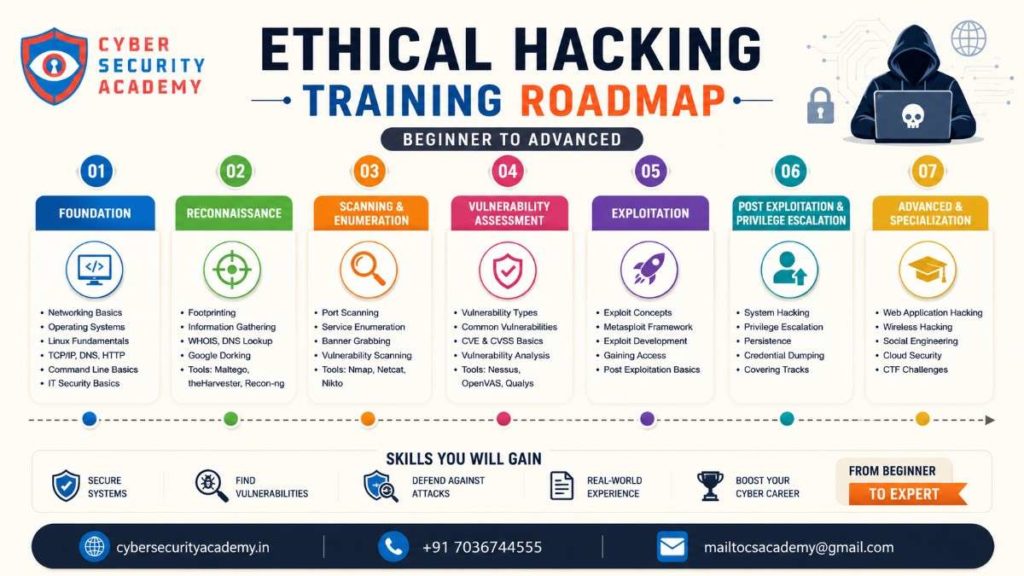
The Ethical Hacking Training Roadmap gives learners a clear path from basic cybersecurity knowledge to practical ethical hacking skills. The learning process starts with networking and operating system fundamentals, then moves into security testing, vulnerability assessment, and penetration testing. The roadmap is designed to help beginners build their skills gradually through practical exercises, labs, and projects.
01
Month 1. Beginner Level – Build the Foundation
- Cybersecurity Fundamentals – Learn security concepts, threats, vulnerabilities, and basic defensive practices.
- Networking Basics – Understand IP addresses, ports, protocols, DNS, TCP/IP, and network communication.
- Linux Fundamentals – Learn Linux commands, file systems, permissions, processes, and basic administration.
- Security Tools Introduction – Become familiar with tools used for network analysis, scanning, and security assessment.
02
Month 2. Intermediate Level – Develop Ethical Hacking Skills
- Reconnaissance and Scanning – Learn information gathering, network discovery, port scanning, and service identification.
- Vulnerability Assessment – Identify security weaknesses, evaluate risks, and prepare vulnerability reports.
- Web Application Security – Study authentication, access control, common web vulnerabilities, and API security.
- Practical Security Labs – Practice security concepts using controlled environments and guided exercise
03
Month 3. Advanced Level – Become Career Ready
- Penetration Testing – Learn structured methods for conducting authorized security assessments.
- Advanced Security Testing – Develop knowledge of network security, cloud security, wireless security, and incident-related concepts.
- Capstone Projects – Complete practical cybersecurity projects and create professional security reports.
- Career Preparation – Prepare for certifications, technical interviews, resumes, and cybersecurity roles such as Ethical Hacker, Penetration Tester, and Vulnerability Analyst.
What Is Ethical Hacking?
- Ethical hacking is the authorized process of testing computer systems, networks, websites, and applications for security weaknesses.
- Ethical hackers work with permission from the system owner before performing any security testing.
- The main purpose is to find vulnerabilities before malicious attackers can exploit them.
- Ethical hacking helps organizations identify weak passwords, insecure configurations, software flaws, and other security risks.
- Ethical hackers use methods similar to attackers, but their goal is to improve security rather than cause damage.
- Common activities include reconnaissance, vulnerability assessment, security testing, and penetration testing.
- Ethical hacking can be used to assess web applications, networks, cloud environments, mobile applications, and computer systems.
- Security findings are documented in reports so organizations can understand the risk and take corrective action.
- Ethical hackers must follow legal, ethical, and agreed testing boundaries throughout an assessment.
- Learning ethical hacking can help students and IT professionals build practical skills for careers in cybersecurity, penetration testing, vulnerability assessment, and security operations.
Where Is Ethical Hacking Used in 2026?
Industry / Area | How Ethical Hacking Is Used |
Web Applications | Tests websites and web applications for vulnerabilities such as broken access controls, injection flaws, and security misconfigurations. |
Cloud Security | Checks cloud environments for insecure configurations, weak identity controls, exposed resources, and other security risks. |
Banking & Finance | Helps financial organizations test applications, networks, APIs, and security controls to reduce the risk of fraud, data theft, and unauthorized access. |
Healthcare | Tests hospital networks, patient portals, electronic health systems, and connected medical devices for security weaknesses. |
Mobile Applications | Assesses Android and iOS applications for insecure authentication, API weaknesses, data exposure, and other vulnerabilities. |
APIs & Software Supply Chains | Tests APIs, third-party integrations, dependencies, and software components for security weaknesses that could affect applications and services. |
IoT & Connected Devices | Evaluates connected devices, wireless networks, firmware, and IoT applications to identify security gaps. |
Corporate Networks | Tests internal and external networks, exposed services, authentication controls, and network configurations to identify possible attack paths. |
Government & Critical Infrastructure | Helps organizations test defenses, identify weaknesses, and assess how well security controls can withstand realistic attacks. |
Security Operations & Red Teaming | Simulates controlled attacks to test detection, incident response, and the overall resilience of security teams. |
Benefits of Ethical Hacking Course in Hyderabad
1. Build Practical Cybersecurity Skills
An Ethical Hacking Course In Hyderabad helps learners develop practical skills in security testing, vulnerability identification, and threat analysis.
2. Learn Through Hands-On Practice
Students can practice cybersecurity concepts through labs, exercises, and controlled security testing environments.
3. Understand Real-World Cyber Threats
The course helps learners understand how common cyber attacks happen and how organizations can reduce security risks.
4. Develop Ethical Hacking Skills
Learners can study reconnaissance, scanning, vulnerability assessment, web security, and penetration testing in authorized environments.
5. Improve Problem-Solving Skills
Ethical hacking requires logical thinking, investigation, analysis, and troubleshooting. Regular practice can strengthen these skills.
6. Explore Cybersecurity Career Opportunities
Training can help learners prepare for roles such as Cybersecurity Analyst, SOC Analyst, Vulnerability Analyst, and Penetration Tester.
7. Learn Industry-Relevant Security Tools
Students can gain practical exposure to commonly used cybersecurity tools for network analysis, vulnerability assessment, and security testing.
8. Build a Strong Cybersecurity Foundation
The course can start with basic networking, operating systems, and security concepts before moving toward advanced topics.
9. Prepare for Cybersecurity Certifications
Structured training can help learners understand the concepts required for relevant ethical hacking and cybersecurity certification exams.
10. Create Practical Projects
Projects allow students to apply their knowledge and build a portfolio that demonstrates their cybersecurity skills.
11. Prepare for Technical Interviews
Training can include technical questions, practical scenarios, and interview preparation related to cybersecurity roles.
12. Understand Legal and Ethical Security Testing
Learners understand the importance of authorization, scope, responsible testing, and ethical practices before assessing any system.
13. Learn From Hyderabad's IT Ecosystem
Learning cybersecurity in Hyderabad can provide access to a large technology environment with opportunities for networking, events, workshops, and professional development.
14. Support Career Growth and Transition
The course can help IT professionals and beginners build cybersecurity knowledge when moving into security-focused roles.
15. Develop Skills for Long-Term Cybersecurity Growth
Cybersecurity is a continuously evolving field. Ethical hacking training provides a foundation that learners can build on through advanced security learning and regular practice.
Thinking of a Ethical Hacking Course in Hyderabad?
- Traditional Ethical Hacking Training
- Classroom-Based Learning – Learn ethical hacking concepts through structured instructor-led classroom sessions.
- Theory-Focused Sessions – Understand cybersecurity concepts, hacking methodologies, vulnerabilities, and security principles before practical work.
- Fixed Learning Schedule – Follow a predefined timetable with regular classes and planned course modules.
- Instructor Explanations – Trainers explain technical topics and demonstrate security concepts step by step.
- Basic Networking Training – Learn IP addresses, ports, protocols, DNS, TCP/IP, and other networking fundamentals.
- Linux Fundamentals – Study Linux commands, file systems, permissions, and basic system administration.
- Ethical Hacking Concepts – Understand reconnaissance, scanning, enumeration, vulnerability assessment, and penetration testing.
- Security Tool Demonstrations – Get demonstrations of commonly used tools for network and security testing.
- Lab-Based Practice – Practice selected techniques in controlled cybersecurity lab environments.
- Traditional Assignments – Complete theory questions, practical exercises, and module-based assignments.
- Regular Assessments – Use tests and quizzes to check understanding of cybersecurity concepts.
- Trainer-Led Doubt Sessions – Ask questions during or after sessions to clarify difficult technical topics.
- Project-Based Learning – Complete structured cybersecurity projects to apply concepts learned during training.
- Certification Preparation – Study core topics that may support preparation for relevant ethical hacking certifications.
- Career Preparation – Receive guidance on cybersecurity roles, resume development, interview preparation, and professional growth.
- Ethical Hacking Academy Training
- Industry-Focused Curriculum – Learn cybersecurity topics based on practical security requirements and current industry practices.
- Structured Learning Path – Progress from cybersecurity fundamentals to ethical hacking, vulnerability assessment, and penetration testing.
- Practical Lab Training – Practice security concepts through controlled labs and simulated environments.
- Live Instructor Guidance – Learn directly from trainers through explanations, demonstrations, and technical discussions.
- Hands-On Security Tools – Gain practical exposure to commonly used tools for network analysis, vulnerability testing, and web security.
- Real-World Security Scenarios – Understand how ethical hackers approach security problems in practical situations.
- Networking and Linux Skills – Build the technical foundation required for cybersecurity and ethical hacking.
- Web Application Security – Learn how to identify common weaknesses in websites, APIs, and web applications.
- Vulnerability Assessment – Learn how to discover, analyze, prioritize, and report security vulnerabilities.
- Penetration Testing Concepts – Understand the stages of authorized penetration testing and security assessment.
- Project-Based Learning – Work on practical cybersecurity projects to apply concepts and develop problem-solving skills.
- Regular Practical Assessments – Measure your progress through assignments, lab exercises, and technical assessments.
- Certification Support – Get guidance for relevant ethical hacking and cybersecurity certification preparation.
- Interview and Career Support – Prepare for technical interviews, resumes, and cybersecurity career opportunities.
- Continuous Skill Development – Build a strong foundation for advanced areas such as SOC operations, cloud security, threat intelligence, and incident response.
Skills You’ll Gain from from Ethical Hacking Classes in Hyderabad
Skills You’ll Gain
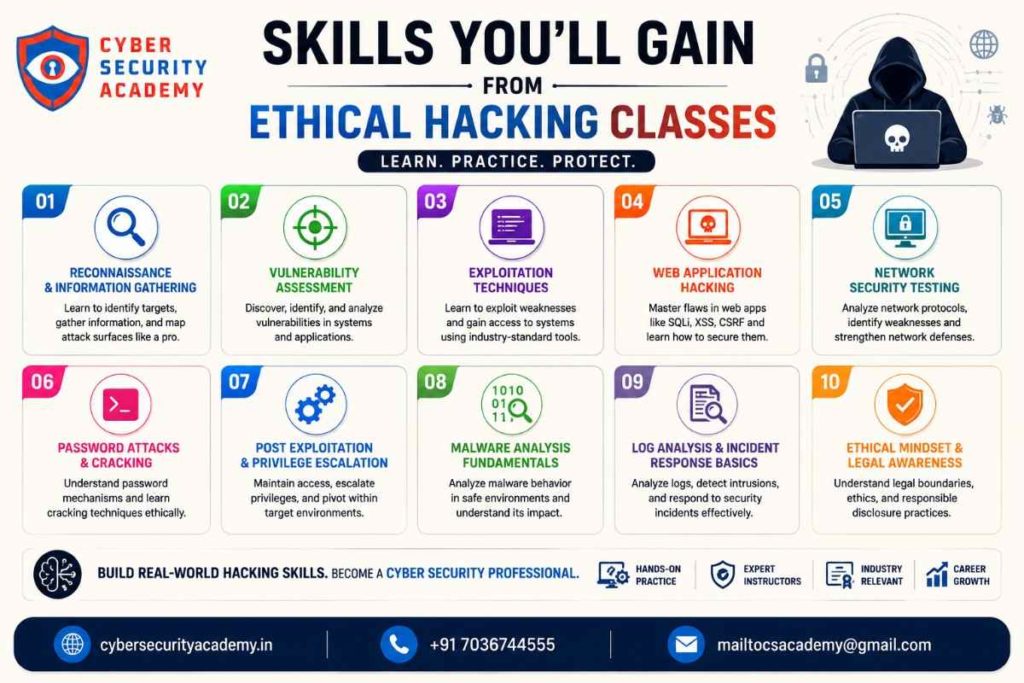
- Cybersecurity Fundamentals – Understand the basic principles of protecting digital systems and data.
- Networking Skills – Learn IP addressing, ports, protocols, DNS, TCP/IP, and network communication.
- Linux Skills – Work with Linux commands, file systems, users, permissions, and security settings.
- Windows Security – Understand Windows users, services, permissions, logs, and basic security controls.
- Reconnaissance Skills – Learn how to collect information about authorized systems and digital assets.
- OSINT Skills – Use publicly available information to support security assessments.
- Network Scanning – Identify available hosts, ports, services, and systems within an authorized environment.
- Enumeration Skills – Gather detailed information about systems, services, and network resources.
- Vulnerability Assessment – Identify and analyze security weaknesses in systems and applications.
- Risk Analysis – Understand how vulnerabilities are prioritized based on their potential impact.
- Web Application Security – Identify common security weaknesses in websites and web applications.
- API Security Basics – Understand common security risks associated with APIs and integrations.
- Penetration Testing – Learn structured methods for performing authorized security assessments.
- Security Tool Usage – Gain practical experience with commonly used cybersecurity tools.
- Password Security – Understand authentication weaknesses and methods for improving credential security.
- Access Control Testing – Learn how to assess authentication and authorization controls.
- Network Security – Understand firewalls, VPNs, IDS/IPS, and basic network protection.
- Wireless Security – Learn the fundamentals of securing and assessing wireless networks.
- Security Monitoring – Understand logs, alerts, and basic security event monitoring.
- SIEM Fundamentals – Learn how security information and event management platforms support threat detection.
- Incident Response Basics – Understand how security teams detect, contain, and respond to incidents.
- Security Reporting – Learn how to document vulnerabilities, risks, evidence, and remediation steps.
- Problem-Solving Skills – Develop analytical and logical thinking for investigating security issues.
- Security Risk Awareness – Understand common attack methods and ways organizations can reduce security exposure.
- Ethical and Legal Security Practices – Learn the importance of authorization, scope, responsible testing, and legal compliance.
Ethical Hacking Capstone Projects in Hyderabad Training
Ethical Hacking Capstone Projects
1. Network Security Assessment Project
Assess an authorized network to identify open ports, exposed services, configuration issues, and potential vulnerabilities. Prepare a security report with findings and recommended improvements.
2. Web Application Security Testing Project
Perform a controlled security assessment of a web application. Identify common security weaknesses related to authentication, access control, input validation, and configuration.
3. Vulnerability Assessment Project
Conduct a structured vulnerability assessment on an authorized environment. Identify vulnerabilities, categorize their severity, and suggest suitable remediation steps.
4. Penetration Testing Project
Complete an end-to-end penetration testing exercise within a defined scope. Document the testing methodology, findings, evidence, risk level, and security recommendations.
5. Wireless Network Security Project
Assess a permitted wireless network for common security configuration weaknesses. Review authentication, encryption, access controls, and overall wireless security posture.
6. Phishing Awareness Simulation Project
Create a safe and authorized phishing-awareness simulation to evaluate employee security awareness. Measure user responses and recommend ways to improve security training.
7. Incident Response Simulation Project
Investigate a simulated cybersecurity incident and follow an incident response process. Identify the event, analyze available evidence, document actions, and prepare an incident report.
8. Final Cybersecurity Audit Project
Combine the skills learned throughout the course in a complete security assessment. Review the authorized environment, identify key risks, prioritize findings, and present a professional cybersecurity report.
Ethical Hacking Tools Covered in Our Ethical Hacking Course in Hyderabad
Tools Covered
NMAP
Burp Suite
Metasploit
Recon-ng
Kali Linux
Nessus
Nikto
Gobuster
Hashcat
SQLmap
OWASP ZAP
Netcat
Ethical Hacking Course Fees & Training Options in Hyderabad
Choose a learning format based on your schedule, preferred learning style, and career goals. Our Ethical Hacking Course in Hyderabad is available through classroom, live online, and recorded training options.
Classroom Ethical Hacking Training
Fee: ₹ 32,000
Best for learners who want direct trainer interaction and hands-on practice in a classroom environment.
- Instructor-led ethical hacking classes
- Hands-on ethical hacking labs
- Networking and Linux fundamentals
- Footprinting and reconnaissance practice
- Network scanning and enumeration
- Vulnerability identification
- System security and authorized hacking exercises
- Web application security testing
- Wireless network security concepts
- Ethical hacking tools practice
- Practical assignments and CTF exercises
- CEH-oriented concept preparation
- Resume and interview preparation
- Career guidance
Live Online Ethical Hacking Training
Fee: ₹ 25,000
Best for students and working professionals who want instructor-led training with the flexibility to learn remotely.
- Live interactive ethical hacking classes
- Trainer-guided practical labs
- Reconnaissance and OSINT exercises
- Network scanning and enumeration practice
- Vulnerability analysis exercises
- Web security and OWASP concepts
- System security demonstrations
- Ethical hacking tool walkthroughs
- Learning materials and revision resources
- Recorded sessions for revision
- Practical assignments
- Trainer doubt-clearing support
- Certification guidance
- Interview preparation support
Recorded Ethical Hacking Training
Fee: ₹ 9,999
Best for learners who prefer flexible, self-paced learning.
- Recorded ethical hacking lessons
- Learn at your own pace
- Networking and Linux basics
- Reconnaissance and scanning concepts
- Enumeration techniques
- Vulnerability analysis lessons
- Web application security concepts
- Ethical hacking tool demonstrations
- Guided practice exercises
- Security lab demonstrations
- Revision learning materials
- Certification preparation resources
- Career and interview resources
Placement Program for Ethical Hacking Training in Hyderabad
Ethical Hacking Placement Program
The Ethical Hacking Placement Program is designed to help learners move from Ethical hacking training to job readiness. It combines technical skill development with resume building, interview practice, practical assessments, and career guidance. The program can help candidates prepare for entry-level opportunities in ethical hacking, cybersecurity, SOC, vulnerability assessment, and penetration testing.
Placement Journey

Skill Assessment

Technical Skill Development

Hands-On Lab Practice

Capstone Project

Resume Preparation

Career Follow-Up Support
Job Application Guidance

Mock Interviews

Technical Interview Preparation

LinkedIn & Professional Profile Support
- Skill Assessment : Evaluate your existing cybersecurity knowledge and identify areas that need improvement.
- Technical Skill Development : Strengthen practical skills in networking, Linux, ethical hacking, vulnerability assessment, and security testing.
- Hands-On Lab Practice : Work on controlled security labs to improve practical knowledge and problem-solving ability.
- Capstone Project : Complete a cybersecurity project that demonstrates your ability to apply ethical hacking concepts.
- Resume Preparation : Create a professional resume that highlights cybersecurity skills, certifications, projects, and practical experience.
- LinkedIn & Professional Profile Support : Improve your professional online profile to present your cybersecurity skills clearly.
- Technical Interview Preparation : Practice common ethical hacking and cybersecurity interview questions with practical scenarios.
- Mock Interviews : Participate in simulated interviews to improve technical answers, communication, and confidence.
- Job Application Guidance : Get guidance on identifying suitable cybersecurity roles and applying for relevant opportunities.
- Career Follow-Up Support : Receive guidance during the job search process and understand how to continue developing skills after placement.
Student Testimonials – Ethical Hacking Course in Hyderabad
Testimonials
The Ethical Hacking Course in Hyderabad focuses on practical learning along with cybersecurity fundamentals. Students can learn ethical hacking, network security, reconnaissance, vulnerability assessment, web application security, penetration testing, and security tools through guided labs and projects. The training is designed for beginners, freshers, career switchers, and working professionals.
Kishore– Beginner

@Kishore
I had no previous experience in ethical hacking when I joined the course. The training started with basic networking, Linux, and cybersecurity concepts and gradually introduced ethical hacking techniques. The step-by-step approach and practical assignments made the learning process easier and helped me understand the fundamentals with confidence.
Nirmala – IT Professional
@Nirmala
I was looking for classroom-based ethical hacking training in Hyderabad where I could interact directly with the trainer. The practical sessions helped me understand web application security, network scanning, vulnerability testing, and penetration testing. The doubt-clearing sessions were also useful when working on the lab exercises.
Akhil – Engineering Graduate
@Akhil
After completing my engineering degree, I wanted to build a career in cybersecurity. This ethical hacking course gave me a structured learning path. I worked on network security, information gathering, vulnerability assessment, penetration testing, and security tools. The project work also helped me build confidence for technical interviews.
Sumithra – Fresher
@Sumithra
As a fresher, I was initially unsure about starting ethical hacking. The training began with networking, Linux, and cybersecurity basics before moving into advanced topics. The practical labs helped me understand reconnaissance, scanning, vulnerability assessment, and web security in a much clearer way.
Ranjith – Working Professional
@Ranjith
I needed ethical hacking training that I could manage alongside my job. The online classes were convenient, and the recorded sessions helped me revise the topics later. I learned about network scanning, web application security, Burp Suite, vulnerability testing, and security reporting through practical exercises.
Ganesh Career Switcher
@Ganesh
I was planning to move into cybersecurity and wanted practical ethical hacking training in Hyderabad. The course helped me understand networking, Linux, reconnaissance, vulnerability assessment, and penetration testing step by step. The hands-on labs and project work made it easier for me to connect the concepts with real security scenarios.
Ethical Hacking Student Community in Hyderabad
What You’ll Get in the Ethical Hacking Student Community
Cybersecurity Knowledge Sharing
Get access to discussions, learning resources, security tips, and useful information related to ethical hacking and cybersecurity.
Peer Learning and Support
Connect with other students and learners to share ideas, discuss technical topics, and learn from different experiences.
Practical Learning Resources
Access useful practice materials, lab exercises, project guidance, and resources that support hands-on cybersecurity learning.
Career and Job Updates
Stay informed about cybersecurity job opportunities, internships, certifications, workshops, and career development activities.
Events, Challenges, and Networking
Participate in cybersecurity events, knowledge-sharing sessions, challenges, and community activities while building connections with other cybersecurity learners and professionals.
Companies Hiring Ethical Hacking Professionals in Hyderabad
Ethical Hacking professionals are hired by MNCs, GCCs, consulting firms, SOC providers, VAPT companies, cloud security teams, and Ethical Hacking startups across Hyderabad and India.
Top MNCs & Enterprise Companies












Ethical Hacking Startups & Specialist Companies








Top Ethical Hacking Certifications in 2026 – Cost, Exam Code, Duration & Career Use
Certification | Cost (USD) | Approx. Cost (INR) | Exam Code / Identifier | Exam Duration | Career Use |
CEH – Certified Ethical Hacker | $1,699 | ₹1,62,577 | 312-50 | 4 Hours | Ethical Hacker, Cybersecurity Analyst, Security Consultant |
eJPT – Junior Penetration Tester | $250 | ₹23,922 | eJPT | Up to 48 Hours | Junior Penetration Tester, Entry-Level Security Tester |
eCPPT – Certified Professional Penetration Tester | $450 | ₹43,060 | eCPPT | Up to 24 Hours | Penetration Tester, Ethical Hacker, Security Consultant |
OSCP+ – Offensive Security Certified Professional Plus | $1,749 | ₹1,67,362 | PEN-200 | 23 Hours 45 Minutes + Documentation Time | Penetration Tester, Red Teamer, Security Consultant |
GPEN – GIAC Penetration Tester | $999 | ₹95,594 | GPEN | 3 Hours | Penetration Tester, Offensive Security Professional |
GWAPT – GIAC Web Application Penetration Tester | $999 | ₹95,594 | GWAPT | 3 Hours | Web Application Security Tester, Penetration Tester |
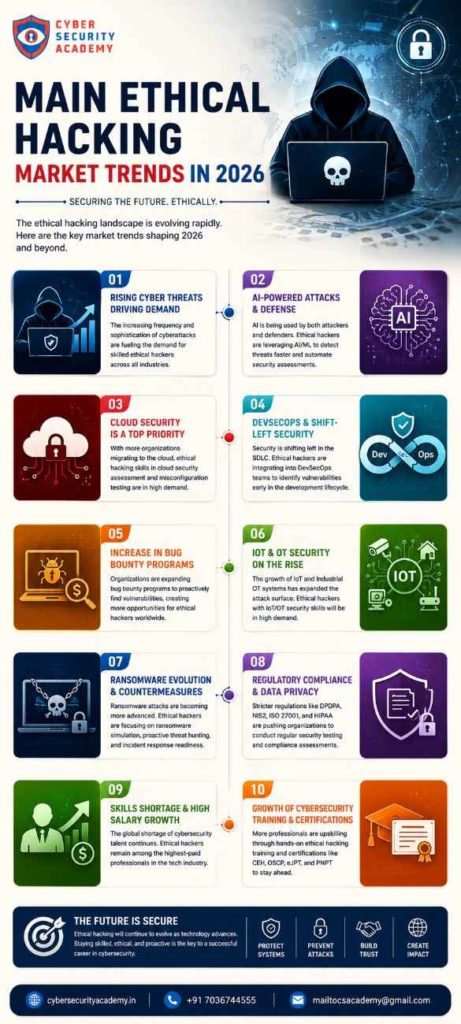
Main Ethical Hacking Market Trends in 2026
Market Trends
- AI-Powered Ethical Hacking – Artificial intelligence is increasingly being used to speed up vulnerability discovery, security testing, threat analysis, and defensive operations.
- AI-Driven Cyber Attacks – Attackers are using AI to automate and accelerate reconnaissance, social engineering, vulnerability discovery, and other stages of attacks.
- Stronger Focus on Identity Security – Stolen credentials, tokens, and weak identity controls are becoming major attack paths, increasing demand for identity-focused security testing.
- Growing Cloud Security Testing – Ethical hackers are increasingly assessing cloud configurations, identities, APIs, workloads, and third-party services for security weaknesses.
- API Security Testing – APIs are becoming an important target for security assessments because exposed or poorly protected APIs can provide access to sensitive data and services.
- AI Application Security – Organizations are beginning to test AI applications and models for risks such as prompt injection, unauthorized actions, insecure integrations, and AI-specific vulnerabilities.
- Software Supply Chain Security – Security testing is expanding to software dependencies, SaaS integrations, CI/CD environments, and other trusted connections that attackers may abuse.
- Automated Vulnerability Management – Faster exploitation of newly disclosed vulnerabilities is increasing the need for continuous scanning, automated validation, and rapid remediation.
- Red Teaming and Adversary Simulation – Organizations are using realistic attack simulations to test security controls, detection capabilities, and incident-response readiness.
- Zero Trust Security Testing – Security teams are increasingly testing identity, access permissions, trust relationships, and continuous verification rather than relying only on network boundaries.
- Cloud and SaaS Identity Testing – Ethical hackers are paying greater attention to SaaS accounts, OAuth tokens, service accounts, and other non-human identities.
- AI-Skilled Cybersecurity Professionals – Employers are increasingly looking for cybersecurity professionals who understand both security fundamentals and AI-related security risks and tools.
- Continuous Security Testing – Security testing is moving from occasional assessments toward more continuous testing so organizations can identify and address vulnerabilities faster as systems change.
Ethical Hacking Job Market Comparison in India (2026)
Metro City | Approx. Ethical Hacking Salary Range | Market Demand | Major Hiring Areas |
Bengaluru | ₹6.5–11 LPA | Very High | Product companies, GCCs, SaaS, cybersecurity firms |
Mumbai | ₹6–10 LPA | Very High | BFSI, fintech, consulting, enterprise security |
Delhi NCR | ₹5.5–9.5 LPA | High | MNCs, consulting, government, BFSI |
Hyderabad | ₹5.5–9 LPA | Very High | IT services, GCCs, cloud security, enterprise technology |
Chennai | ₹5–8 LPA | High | IT services, enterprise technology, automotive and manufacturing |
FAQs – Ethical Hacking Course in Hyderabad
FAQS
1. What is an Ethical Hacking Course in Hyderabad?
An Ethical Hacking Course in Hyderabad teaches students how to identify, assess, and report security vulnerabilities in authorized systems, networks, websites, and applications.
2. In 2026, will ethical hacking be a good career?
Yes. Ethical hacking can be a strong career option for people interested in cybersecurity, penetration testing, vulnerability assessment, and security operations.
3. Who can join an ethical hacking course?
Students, graduates, IT professionals, networking professionals, software professionals, and cybersecurity beginners can join the course.
4. Can beginners learn ethical hacking?
Yes. Beginners can start with cybersecurity, networking, Linux, and operating system fundamentals before moving to advanced security topics.
5. Do I need programming knowledge to learn ethical hacking?
Advanced programming is not required to start. Basic scripting and programming knowledge can become useful as you progress.
6. What are the prerequisites for an ethical hacking course?
Basic computer knowledge and an interest in cybersecurity are usually enough to begin. Knowledge of networking can be helpful.
7. What topics are covered in an ethical hacking course?
Topics can include networking, Linux, reconnaissance, scanning, enumeration, vulnerability assessment, web security, penetration testing, and security reporting.
8. Which tools are taught in ethical hacking training?
Depending on the curriculum, students may work with tools such as Nmap, Wireshark, Burp Suite, Metasploit, Kali Linux, Nessus, and OWASP ZAP.
9. Is practical training included in the course?
A quality ethical hacking program should include hands-on labs, guided exercises, and controlled environments for practicing security concepts.
10. How long does an ethical hacking course take?
The duration depends on the syllabus, training format, practical labs, and learning schedule. Courses can range from a few weeks to several months.
11. Is classroom ethical hacking training available in Hyderabad?
Many training providers offer classroom-based cybersecurity and ethical hacking programs in Hyderabad. Availability depends on the institute and location.
12. Are online ethical hacking courses available?
Yes. Online programs can provide live instructor sessions, recorded lessons, practical labs, assignments, and trainer support.
13. Which is better, online or classroom ethical hacking training?
Both can work well. Classroom training offers direct interaction, while online learning provides greater flexibility. Practical lab access is important in either format.
14. What certification can I pursue after ethical hacking training?
Students can consider certifications such as CEH, eJPT, eCPPT, OSCP+, GPEN, and other cybersecurity credentials based on their experience and career goals.
15. Is CEH useful for an ethical hacking career?
CEH can help demonstrate foundational ethical hacking knowledge. Its value depends on the employer, role, practical skills, and other qualifications you have.
16. Can an ethical hacking course help me get a job?
Training can improve technical knowledge and job readiness, but employment depends on your skills, practical experience, interview performance, certifications, and the hiring company.
17. What jobs can I get after completing an ethical hacking course?
Possible career paths include Ethical Hacker, Junior Penetration Tester, Vulnerability Analyst, Cybersecurity Analyst, SOC Analyst, and Web Security Tester.
18. What salary can an ethical hacker expect in Hyderabad?
Salary varies based on experience, practical skills, certifications, job role, and employer. Entry-level packages can differ significantly across companies.
19. Does the course include placement assistance?
Placement support depends on the training provider. It may include resume preparation, mock interviews, job alerts, interview preparation, and career guidance.
20. Are real-world projects included in ethical hacking training?
A practical course may include capstone projects such as vulnerability assessments, network security assessments, web application testing, and penetration testing exercises.
21. What is the difference between ethical hacking and penetration testing?
Ethical hacking is a broader security-testing concept, while penetration testing is a structured process used to simulate authorized attacks and assess security controls.
22. Is ethical hacking legal?
Ethical hacking is legal when you have proper authorization from the system owner and stay within the agreed scope of the security assessment.
23. Can I learn ethical hacking after graduation?
Yes. Graduates from different educational backgrounds can learn ethical hacking if they develop the required technical fundamentals.
24. Can working IT professionals join an ethical hacking course?
Yes. Working professionals can use cybersecurity training to develop new skills or transition into security-focused roles.
25. Does ethical hacking training teach web application security?
Yes. Many courses cover web application security topics such as authentication, access control, common vulnerabilities, API security, and security testing.
26. Will I learn Linux in an ethical hacking course?
Most practical ethical hacking programs include Linux fundamentals because Linux environments and command-line skills are commonly used in cybersecurity labs.
27. What skills will I gain from ethical hacking training?
You can develop skills in networking, reconnaissance, vulnerability assessment, security testing, web security, penetration testing, security tools, reporting, and problem-solving.
28. How do I choose the best Ethical Hacking Course In Hyderabad?
Compare the syllabus, practical labs, trainer experience, projects, training mode, certification guidance, career support, reviews, and overall learning methodology.
29. Is ethical hacking suitable for a career change?
Yes. IT, networking, system administration, software, and technical professionals can use ethical hacking training as a pathway toward cybersecurity roles.
30. Why choose an Ethical Hacking Course In Hyderabad?
Hyderabad has a large IT and technology ecosystem. A well-designed course can provide structured learning, practical cybersecurity training, project experience, and preparation for security careers.
Other Relevant Courses

Got more questions?
Talk to Our Team Directly
Contact us and our academic councellor will get in touch with you shortly.