
Penetration Testing Training in Hyderabad
Scope. Test. Evidence. Report.
Penetration testing training in Hyderabad at Cyber Security Academy teaches you to deliver an authorised engagement end to end — scoping and rules of engagement, reconnaissance, enumeration, vulnerability validation, web, API, network and Active Directory testing, evidence capture, risk rating and a professional report. Twenty modules and five assessments over three months, classroom in Kukatpally or live online.

Course snapshot
 Duration
3 months
Duration
3 months
 Mode
Classroom + live online
Mode
Classroom + live online
 Modules
20 modules, 14 tools
Modules
20 modules, 14 tools
 Level
Beginner to job-ready tester
Level
Beginner to job-ready tester
 Next batch
2 November 2026
Next batch
2 November 2026
 Location
Kukatpally, Hyderabad
Location
Kukatpally, Hyderabad
Penetration Testing Training in Hyderabad — Quick Facts
Everything a prospective learner asks a counsellor in the first two minutes.
Course
Penetration Testing Training in Hyderabad
Location
Kukatpally, Hyderabad
Training mode
Classroom + live online + recorded
Duration
3 months
Classroom fee
₹32,000
Online fee
₹25,000
Recorded course
₹9,999, lifetime access
Curriculum
20 modules, 14 tools, 5 assessments
Key areas
Methodology, web, API, network, Active Directory, reporting
Certification prep
eJPT, CompTIA PenTest+, Burp Practitioner, OSCP
Next batch
2 November 2026
Prerequisites
None. Networking, Linux and Windows taught from scratch.
Placement support and career outcomes
What we do, stated plainly, and what we do not claim.
Resume and portfolio review
Your CV is rebuilt around the five assessments you actually delivered, using the terms VAPT hiring managers screen for.
Assessment-based interviews
Technical rounds on methodology, OWASP categories, privilege boundaries and evidence, plus the round every testing interview uses: walk me through a finding you reported.
Job-role selection
Web testing, API testing, network assessment and red teaming are different careers. We help you pick the one that fits how you work.
LinkedIn profile setup
Headline, skills, certifications and project section, so recruiter search surfaces you for VAPT roles.
Internship certificate
The classroom programme includes an internship certificate based on your completed capstone project work.
What we don't promise
No job guarantee, no guaranteed salary, no placement percentage. Any institute quoting those numbers cannot evidence them either.
Companies hiring penetration testers in Hyderabad
MNCs, global capability centres, consulting firms and specialist VAPT providers advertising testing roles in the Hyderabad market. We prepare you for their interview process. We are not claiming a hiring partnership with them.
Why choose this penetration testing training in Hyderabad
Every reason below is something you can verify before you pay.
Our penetration testing training in Hyderabad follows a real engagement in order: pre-engagement and authorisation, scope definition, reconnaissance, enumeration, validation, testing, evidence, risk rating, report, retest. Methodology comes before exploitation, which is the opposite of how most courses are built.
Twenty modules cover web application and API testing, external and internal network assessment, Windows and Active Directory review, privilege and identity security, evidence capture and CVSS risk rating, and a full module on professional reporting.
It finishes with five documented assessments — web, API, network, access control, and a final capstone engagement delivered the way a client receives it.
Book a free demo class
See a real session before you commit — no obligation.
Methodology before exploitation
Pre-engagement, authorisation, scope and rules of engagement come in module 4, before any testing. This is what separates a tester from a tool operator.
Reporting is a full module
The report is the deliverable a client pays for. Executive summary, scope, methodology, findings, evidence, remediation.
Validation, not scanning
Removing false positives and proving a finding is real is the core commercial skill. Scanners cannot do it.
Web and API as separate disciplines
Five modules on web fundamentals, testing, authentication, authorisation and API security.
Active Directory assessment
Domains, permissions and attack paths in a controlled lab. Internal engagements are won or lost here.
Access control testing in depth
Horizontal and vertical privilege boundaries — the most commonly reported real-world finding.
Evidence and risk rating
Proving impact without damaging a client environment, then rating it defensibly with CVSS.
Retesting included
How remediation works, how retest scope is agreed and how closure is reported. Standard commercially, rarely taught.
Five documented assessments
Web, API, network, access control and a full capstone engagement. Each ends in a written report.
Networking, Linux and Windows from zero
Three modules before any testing tool, so beginners are not lost in week three.
Classroom option in Kukatpally
In-person batches at our Nizampet X Roads centre, plus live online for everyone else.
EMI and instalment options
Classroom and online fees can be paid in EMI or two instalments.

Penetration Testing Course Syllabus — 20 Modules
Twenty modules that follow a real engagement from pre-engagement authorisation to the retest — the topics, the lab and the outcome for each one.
Introduction to Penetration Testing
What a paid engagement is, who buys it and why.
You will cover
✓ What pentesting means
✓ Engagement types
✓ Client expectations
✓ Deliverables
Outcome: you understand the commercial product you are being trained to deliver.
Networking Fundamentals for Testers
You cannot test a service you cannot describe.
You will cover
✓ IP, ports, TCP and UDP
✓ DNS
✓ HTTP and HTTPS
✓ Network services
Lab: map a lab network and describe every exposed service.
Linux and Windows Fundamentals
The two operating systems every engagement touches.
You will cover
✓ Linux command line
✓ Files and permissions
✓ Windows users and groups
✓ Services and processes
Outcome: comfortable on both before any exploitation.
Penetration Testing Methodology
The module that separates a tester from someone running tools.
You will cover
✓ Pre-engagement
✓ Authorisation
✓ Scope definition
✓ Rules of engagement
Outcome: you can scope an engagement and write the rules of engagement.
Reconnaissance and Attack Surface Mapping
Establishing what is actually in scope and reachable.
You will cover
✓ Passive gathering
✓ Active gathering
✓ Domain and DNS mapping
✓ Attack surface documentation
Lab: produce a documented attack surface for an authorised target.
Network Discovery and Enumeration
Turning a range into an inventory.
You will cover
✓ Host discovery
✓ Port scanning
✓ Service identification
✓ OS fingerprinting
Tools: Nmap, Netcat.
Vulnerability Assessment and Validation
Where scanners stop and testers start.
You will cover
✓ Scanners
✓ Manual verification
✓ False positive removal
✓ Evidence gathering
Outcome: you can prove a finding is real, which is the whole job.
Web Application Fundamentals
How an application works before you test one.
You will cover
✓ Request and response
✓ Sessions and cookies
✓ Roles and permissions
✓ Application logic
Tools: Burp Suite, browser developer tools.
Web Application Penetration Testing
The largest single source of findings in commercial work.
You will cover
✓ Input handling
✓ Injection categories
✓ Configuration issues
✓ OWASP-aligned testing
Lab: a full authorised web application assessment.
Authentication and Session Testing
Login, account management and everything around them.
You will cover
✓ Login security
✓ Password policy
✓ Session handling
✓ Account management controls
Lab: authentication and session review on a training application.
Authorization and Access Control Testing
The category most commonly missed by scanners.
You will cover
✓ User roles
✓ Horizontal access control
✓ Vertical access control
✓ Privilege boundaries
Outcome: broken access control is the most reported real-world finding.
API Penetration Testing
The surface that grew fastest and is tested least.
You will cover
✓ REST fundamentals
✓ Endpoints and methods
✓ Authentication and authorisation
✓ Object-level access
Lab: a documented API security assessment.
Network Penetration Testing
External and internal assessment as separate disciplines.
You will cover
✓ External assessment
✓ Internal assessment
✓ Service testing
✓ Segmentation review
Lab: an approved lab network assessment, end to end.
Windows and Active Directory Assessment
Where internal engagements are won or lost.
You will cover
✓ Domains and users
✓ Groups and permissions
✓ Attack paths
✓ Configuration review
Lab: AD attack path review inside a controlled lab.
Privilege Security Concepts
How limited access becomes administrative access.
You will cover
✓ User privileges
✓ Administrative privileges
✓ File permissions
✓ Misconfiguration patterns
Outcome: you can explain and evidence a privilege issue.
Password and Identity Security Assessment
Identity as the most exploited control.
You will cover
✓ Password security
✓ Authentication controls
✓ Policy review
✓ Identity risks
Outcome: the findings clients act on fastest.
Security Evidence and Risk Rating
Proving a finding without breaking the client.
You will cover
✓ Evidence capture
✓ Impact analysis
✓ Risk rating
✓ Business context
Outcome: defensible evidence and a rating you can justify.
Professional Penetration Testing Reporting
The deliverable. This is what the client actually pays for.
You will cover
✓ Executive summary
✓ Scope and methodology
✓ Findings and evidence
✓ Remediation guidance
Lab: write a full professional report for a real assessment.
Remediation and Retesting
What happens after the report lands.
You will cover
✓ How remediation works
✓ Retest scope
✓ Verification
✓ Closure reporting
Outcome: retesting is standard in commercial engagements and rarely taught.
Final Penetration Testing Capstone
A complete authorised assessment, delivered like a real engagement.
You will cover
✓ Scoping
✓ Testing
✓ Evidence
✓ Client-ready report
Outcome: the portfolio piece you take into interviews.
Penetration testing tools you will use
Each tool, what it does, and where it shows up in the labs and projects.
Penetration testing skills you will learn
Twelve concrete capabilities you walk out with, aligned to what VAPT hiring managers screen for.
Engagement scoping
Pre-engagement, authorisation, scope definition and rules of engagement.
Attack surface mapping
Documenting exactly what is in scope and reachable before testing.
Enumeration
Turning an IP range into a documented service inventory.
Finding validation
Removing false positives and proving a scanner result is real.
Web application testing
Input handling, injection, configuration and application logic.
Access control testing
Horizontal and vertical privilege boundaries — the most reported real finding.
API testing
Endpoints, methods, authentication and object-level authorisation.
Network testing
External and internal assessment as separate disciplines.
Active Directory review
Domain identities, permissions and attack paths in a controlled lab.
Evidence capture
Proving impact without damaging the client environment.
Risk rating
CVSS scoring with business context, defensible under challenge.
Professional reporting
Executive summary, methodology, findings, evidence and remediation.
Penetration testing assessments you will deliver
Five authorised assessments, run in a controlled lab. Each one ends in a written report, which is the actual deliverable a client pays for.
Web application penetration test
API security assessment
Network penetration test
Authentication and access control assessment
Final capstone engagement
Who can join this penetration testing training?
Suitable for a wide range of learners. No prior security experience is required to start.
Freshers and students
Start from networking and Linux fundamentals. No prior security experience needed.
SOC and security analysts
Move from detecting attacks to running authorised ones.
Testers and QA engineers
Structured test methodology transfers almost directly.
Developers
Understand the findings that land on your backlog, and why they matter.
Network engineers
You know the protocols. Learn to assess them under a defined scope.
System administrators
Windows, Linux and AD knowledge is exactly what internal engagements use.
Career switchers
A structured path into VAPT and application security testing.
Future penetration testers
Ready to move from learning about attacks into delivering authorised, billable assessments? This is the path.
Scope · Test · Evidence · ReportWhich certification suits a penetration tester?
Certifications help. A portfolio of written assessments helps more. Here is the sequence that fits a testing career.
Junior Penetration Tester

Offensive Security Certified Professional
You do not need every certification. Choose based on your experience, your target role and your budget. A candidate with five well-written assessment reports and eJPT will usually beat a candidate with four certificates and nothing to show. Note that OSCP examines documentation as well as exploitation, which is exactly what module 18 trains. Certification names, formats and prices change, so verify with the provider before booking.
Certification path we prepare you for
What you receive on completion
On completing the programme you receive a Cyber Security Academy course completion certificate — a record of the modules you finished and the assessments you delivered. It is separate from any vendor certification, which is issued by the certifying body.
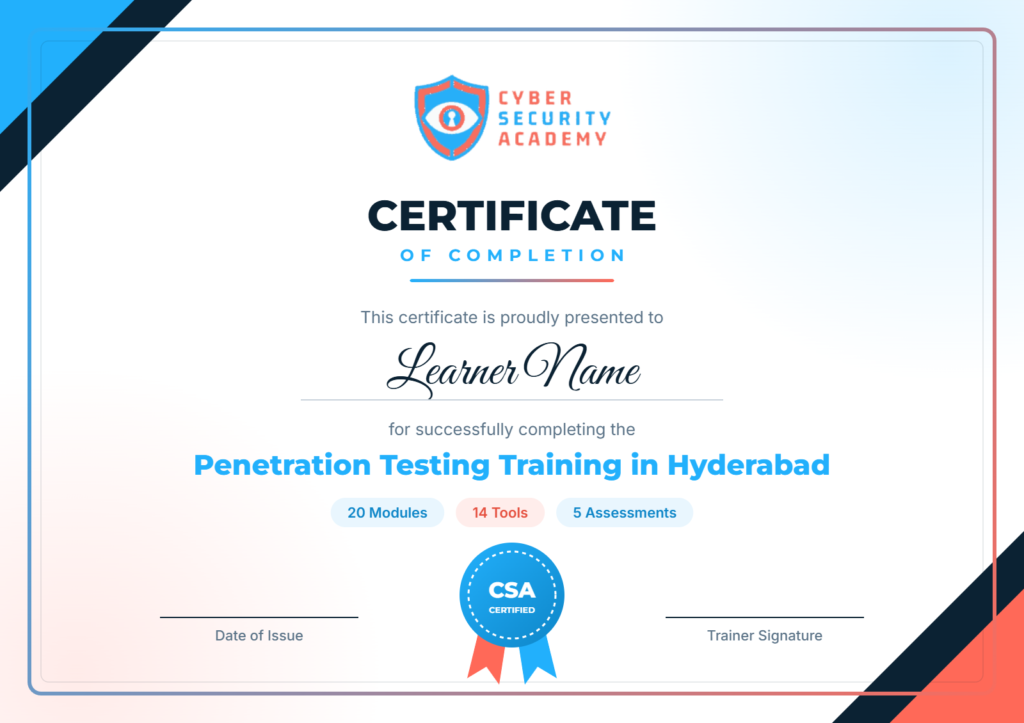 Sample · course completion certificate
Your trainer
 Lead Trainer
Mr. Praveen K
Lead trainer, penetration testing and security assessment.
10+ years of industry experience, teaching engagement methodology, web and API testing, network and Active Directory assessment and professional reporting from the perspective of someone who has delivered real engagements rather than only studied them.
Specialisations
Web and API penetration testing, network and Active Directory assessment, vulnerability validation, risk rating and reporting.
Teaching approach
Every concept lands in a lab the same session. No module ends without something tested and documented.
Mentorship
1:1 career mentorship and guidance on which certification path fits your background and budget.
Support
Doubt-clearing sessions, technical support and WhatsApp learning support between classes.
Learning modes and upcoming batches
Three ways to take the same 20-module syllabus.
Recorded course
Lifetime access ₹9,999✓ Fundamentals to advanced modules
✓ 1 capstone project included
✓ Tools walkthrough and certification guidance
✓ WhatsApp learning support
Classroom
Starts 2 November 2026 ₹32,000✓ 3 months, instructor-led practical training
✓ 5 documented assessments, 14 tools
✓ 24/7 lab access
✓ Internship certificate and placement assistance
Live online
Weekday and weekend ₹25,000✓ Live interactive classes, same trainer
✓ Daily recordings and LMS access
✓ Hands-on labs and real projects
✓ Placement assistance and mock interviews
EMI and two-instalment payment options are available on classroom and online training.
Check us out before you enrol
We would rather you verify everything than take our word for it. Here is exactly how.
Sit in on a live class
Book a free demo and watch an actual session — the trainer, the pace, the lab setup and the batch you would join. Nothing is staged for visitors.
Read our Google reviews
Open our Google Business Profile and read what learners wrote there. Google reviews are tied to real accounts, which is why we point you to them rather than printing quotes here.
Read reviews on GoogleAsk to see a real report
Ask what a finished penetration test report looks like. In this field the report is the product. If an institute cannot show you one, the projects are a line on a brochure.
Ask about lab access
Ask how many hours a day you can reach the lab and on whose infrastructure. Hands-on time is the difference between a certificate and a skill.
Ask how they teach scope
Ask how pre-engagement, authorisation and rules of engagement are taught. Any course that skips this is training you to work without a safety net.
Compare the syllabus
Our full 20-module syllabus is on this page. Compare it module by module — particularly on API testing, evidence and risk rating, reporting and retesting, which most syllabuses skip.
Penetration tester salary in Hyderabad
Indicative market ranges by role and level. These are estimates, not offers.
Indicative annual range. Freshers, 0–2 years.
Indicative annual range. Mid-level, 3–5 years.
Indicative annual range. Freshers to mid-level.
Indicative annual range. Mid-level, 3–5 years.
Indicative annual range. Experienced, 5+ years.
Indicative annual range. Mid-level, 3–5 years.
Disclaimer. Salary figures shown are indicative market estimates and are not a guarantee of earnings. Actual compensation depends on experience, skills, certifications, employer and interview performance.
Career opportunities after penetration testing training
The roles this syllabus maps to, and what each one is actually accountable for.
Junior Penetration Tester
Supports authorised assessments under supervision. Key skills: enumeration, validation, documentation.
Penetration Tester
Runs structured assessments and prepares findings. Key skills: methodology, exploitation, reporting.
VAPT Analyst
Combined vulnerability assessment and penetration testing delivery. Key skills: Nessus, Burp Suite, CVSS.
Vulnerability Analyst
Finds, validates, prioritises and tracks vulnerabilities. Key skills: scanning, triage, remediation tracking.
Web Application Security Tester
Focused on application security controls. Key skills: OWASP testing, access control, Burp Suite.
API Security Tester
Authentication, authorisation and object-level access on APIs. Key skills: REST, tokens, Burp Suite.
Application Security Analyst
Works with developers to reduce application risk. Key skills: secure development, triage, communication.
Security Consultant
Client-facing assessment and advisory. Key skills: breadth, scoping, written communication.
Offensive Security Analyst
Supports authorised offensive testing programmes. Key skills: tooling, evidence, tradecraft.
Red Team Operator
Adversary simulation against mature defences. Key skills: evasion, OPSEC, attack paths.
Security Assessment Consultant
Delivers assessments across environments for multiple clients. Key skills: methodology, reporting.
Cloud Security Tester
Reviews cloud configuration and identity controls. Key skills: IAM, misconfiguration, assessment.
Penetration testing roadmap: beginner to job-ready
The order matters. Starting on exploitation tools before networking is the most common reason learners stall.
Foundations
Networking, Linux and Windows. Taught before any testing tool.
• Networking
• Linux
• Windows
Methodology
Pre-engagement, authorisation and scope. The module that makes the rest legal.
• Rules of engagement
• Scope definition
• Attack surface mapping
Discovery and validation
Turning a scope into verified, real findings.
• Enumeration
• Vulnerability validation
• False positive removal
Testing surfaces
Web, API, network and Active Directory as separate disciplines.
• Web and API
• Network
• AD and privileges
Deliver
Evidence, risk rating, the report and the retest. This is what you are paid for.
• Evidence and CVSS
• Professional report
• Remediation and retest
Vulnerability assessment vs penetration testing vs ethical hacking
Three terms used interchangeably in adverts, but they are different jobs with different deliverables.
Penetration testing and security assessment trends in 2026
Three things specific to this city and this year.
Access control is the priority
Modern applications carry many roles, users, APIs and resources. Testing whether the right person can reach the right resource is now the most valuable application security activity, and the one scanners handle worst.
API testing is under-supplied
APIs expose more than the front end ever shows. Demand for testers who can assess authentication, authorisation and object-level access is rising faster than the supply of people trained to do it.
The report is the product
Clients buy a document, not a scan. Testers who write clearly, rate risk defensibly and explain remediation get rehired. It is the skill that most separates pay bands in this field.
Common questions, answered directly
Is penetration testing a good career in 2026? Yes, if you can test methodically and write up what you found. The demand is for people who produce defensible reports, not people who run scanners.
Can a fresher get in? Yes, though it is a narrower door than SOC. Junior tester and VAPT analyst roles hire on practical evidence, which is why the five written assessments matter more than the certificate.
How do I start? Networking, Linux and Windows, then methodology and scope, then enumeration and validation, then web, API, network and AD, then evidence, reporting and retest. In that order.
Frequently asked questions
The twenty questions counsellors are asked most often, answered plainly.
What is penetration testing training in Hyderabad?
It is instructor-led training in delivering an authorised security engagement end to end — scoping and rules of engagement, reconnaissance, enumeration, vulnerability validation, web, API, network and Active Directory testing, evidence capture, risk rating and a professional report. Twenty modules over three months, classroom in Kukatpally or live online.
What is the difference between penetration testing and ethical hacking?
Ethical hacking is the broad study of attacker methods across many surfaces. Penetration testing is a defined, scoped, authorised engagement that produces a report a client pays for. Our ethical hacking course teaches how attacks work. This course teaches how to deliver an engagement: scoping, validation, evidence, risk rating, reporting and retesting.
What is the difference between vulnerability assessment and penetration testing?
A vulnerability assessment is usually broad and scanner-led, producing a list of possible weaknesses. A penetration test has a defined scope, combines tools with manual testing, validates findings, assesses real impact and produces detailed evidence and remediation guidance. Retesting is a normal part of a professional engagement.
Is a scanner not enough?
No. Scanners produce false positives, duplicates, low-risk noise and findings without business context. A tester asks whether the finding is real, whether the system is actually exposed, whether another control reduces the risk, what the realistic impact is, and whether the fix worked. That human validation is the core skill this course teaches.
What is the duration of the course?
Three months. Classroom and live online batches follow the same 20-module syllabus, with weekday and weekend options so you can fit it around work.
What is the penetration testing course fee in Hyderabad?
Classroom training is ₹32,000, live online training is ₹25,000 and the recorded course is ₹9,999. EMI and two-instalment payment options are available. Certification exam fees are paid separately to the certifying body.
Do I need a technical background?
No. The course starts with networking, Linux and Windows fundamentals before any testing tool. SOC analysts, testers, developers, network engineers and complete beginners all start from the same point.
Is penetration testing legal?
Yes, when it is authorised and in scope. Module 4 covers pre-engagement, authorisation, scope definition and rules of engagement before any testing begins. Every lab in this course runs against approved training environments.
What types of penetration testing are covered?
Web application, API, external network, internal network, Active Directory assessment and cloud configuration review. Each is treated as its own discipline rather than a single generic exercise.
Is API testing included?
Yes, as its own module: REST fundamentals, endpoints and methods, authentication and authorisation, and object-level access. API testing is the fastest-growing assessment type and the one fewest testers can do well.
Is Active Directory covered?
Yes. Domains, users, groups, permissions, configuration review and attack paths, all inside a controlled lab. Internal engagements are usually won or lost in Active Directory.
Is report writing covered?
Yes, as a full module, and it matters more than most learners expect. The report is the deliverable a client pays for: executive summary, scope, methodology, findings, evidence, impact and remediation. Every capstone produces one.
Is retesting covered?
Yes. Finding the vulnerability is not the last step. You learn how remediation works, how retest scope is agreed, how fixes are verified and how closure is reported — standard in commercial engagements and rarely taught.
Are real projects included?
Five: a web application penetration test, an API security assessment, a network penetration test, an authentication and access control assessment, and a final capstone engagement delivered like a client engagement.
Which certification should I aim for?
eJPT for entry-level practical skills, CompTIA PenTest+ for methodology and vulnerability management, Burp Suite Certified Practitioner for web depth, and OSCP for practical offensive skill. GPEN and GWAPT are alternatives. Certification names, formats and prices change, so verify with the provider before booking.
What job roles can I apply for?
Junior Penetration Tester, Penetration Tester, VAPT Analyst, Vulnerability Analyst, Web Application Security Tester, API Security Tester, Application Security Analyst and Security Consultant.
What salary can I expect in Hyderabad?
Junior testing roles commonly advertise around ₹4–7 LPA, with mid-level penetration testers around ₹9–16 LPA. These are indicative market ranges, not a guarantee.
Is the training available online?
Yes. Live online batches run the same syllabus with the same trainer, with remote lab practice, recorded sessions and LMS access.
Is placement assistance provided?
Yes: resume preparation built around your five assessments, LinkedIn support, technical interview preparation, mock interviews and job application support. We do not guarantee placement.
Is there a job guarantee?
No. We do not guarantee placement or any salary outcome. What we provide is job-oriented training, five documented assessments as a portfolio, interview preparation and placement assistance. The hiring decision belongs to the employer.
Ready to start your
penetration testing career?
Sit in on a live session before you commit. You will see the curriculum, the trainer, the lab setup, the batch timings and how the projects work.
No obligation. Speak with a course counsellor and find out whether this programme is right for you.
Other courses at Cyber Security Academy
Visit or contact us
Our centre is at Dr Atmaram Estates, Nizampet X Roads, close to KPHB and JNTU.
 Find us on Google Maps
Dr Atmaram Estates, Nizampet X Roads
Open map →
Find us on Google Maps
Dr Atmaram Estates, Nizampet X Roads
Open map →