
Network Security Course in Hyderabad
Firewalls, IDS, VPN and Zero Trust
The network security course in Hyderabad at Cyber Security Academy is three months of instructor-led training in securing networks — firewalls, IDS and IPS, VPNs, segmentation, wireless security, network authentication, monitoring and Zero Trust architecture. Eighteen modules, sixteen tools and five documented projects, delivered as classroom batches in Kukatpally or live online.

Course snapshot
 Duration
3 months
Duration
3 months
 Mode
Classroom + live online
Mode
Classroom + live online
 Modules
18 modules, 16 tools
Modules
18 modules, 16 tools
 Level
Beginner to job-ready engineer
Level
Beginner to job-ready engineer
 Next batch
2 November 2026
Next batch
2 November 2026
 Location
Kukatpally, Hyderabad
Location
Kukatpally, Hyderabad
Network Security Course in Hyderabad — Quick Facts
Everything a prospective learner asks a counsellor in the first two minutes.
Course
Network Security Course in Hyderabad
Location
Kukatpally, Hyderabad
Training mode
Classroom + live online + recorded
Duration
3 months
Classroom fee
₹32,000
Online fee
₹25,000
Recorded course
₹9,999, lifetime access
Curriculum
18 modules, 16 tools, 5 projects
Key areas
Firewalls, IDS/IPS, VPN, segmentation, wireless, Zero Trust
Certification prep
CompTIA Network+, Security+, CCNA Security path
Next batch
2 November 2026
Prerequisites
None. OSI, TCP/IP and subnetting taught from scratch.
Placement support and career outcomes
What we do, stated plainly, and what we do not claim.
Resume and portfolio review
Your CV is rebuilt around the five network projects you actually built, using the terms infrastructure hiring managers screen for.
Scenario-based interviews
Technical rounds on subnetting, firewall rules, TLS and segmentation, plus the round every network interview uses: design a secure network for this scenario.
Job-role selection
Firewall administration, network security engineering and security architecture are different paths. We help you pick the one that fits how you work.
LinkedIn profile setup
Headline, skills, certifications and project section, so recruiter search surfaces you for network security roles.
Internship certificate
The classroom programme includes an internship certificate based on your completed capstone project work.
What we don't promise
No job guarantee, no guaranteed salary, no placement percentage. Any institute quoting those numbers cannot evidence them either.
Companies hiring network security engineers in Hyderabad
MNCs, global capability centres, managed service providers and network operations teams advertising network and infrastructure security roles in Hyderabad. We prepare you for their interview process. We are not claiming a hiring partnership with them.
Why choose this network security course in Hyderabad
Every reason below is something you can verify before you pay.
Our network security course in Hyderabad follows a network from the bottom up: OSI and TCP/IP, addressing and subnetting, protocols and services, then traffic analysis, then the controls — firewalls, IDS and IPS, VPN, segmentation, wireless and network access control.
Eighteen modules cover cryptography for networks, network attacks and their countermeasures, monitoring and logging, Zero Trust architecture, cloud network security and secure network design. You configure the controls rather than watch them demonstrated.
It finishes with five documented projects — a firewall build and rule audit, a segmentation design, a traffic investigation, a wireless assessment and a full architecture review.
Book a free demo class
See a real session before you commit — no obligation.
Subnetting taught properly
IPv4, IPv6 and CIDR designed rather than memorised. It is the first thing every network security interview tests.
You configure a real firewall
Design a rule set from scratch, apply least privilege, then audit and document every rule.
IDS and IPS with tuning
Signature versus anomaly detection, and keeping false positives under control with Snort, Suricata and Zeek.
Segmentation as a discipline
VLANs, DMZ design and east-west control. Segmentation is what turns a breach into a contained incident.
VPN built, not described
IPsec and TLS tunnels configured and tested with OpenVPN and WireGuard.
Zero Trust as its own module
Micro-segmentation, identity-centric access and continuous verification. Where enterprise design is heading.
Cloud network security
Virtual networks, security groups, cloud firewalls and hybrid connectivity, with an exposure review lab.
Attacks and countermeasures together
Spoofing, man in the middle, DoS and DNS attacks observed in a lab, then the control that stops each one.
TLS explained end to end
Certificates, the handshake and cipher selection. The question interviews ask most and candidates answer worst.
Five documented projects
Firewall build, segmentation design, traffic investigation, wireless assessment and architecture review.
Classroom option in Kukatpally
In-person batches at our Nizampet X Roads centre, plus live online for everyone else.
EMI and instalment options
Classroom and online fees can be paid in EMI or two instalments.

Network Security Course Syllabus — 18 Modules
Eighteen modules that follow a network from the physical layer to Zero Trust architecture — the topics, the lab and the outcome for each one.
Network Security Fundamentals
What network security actually protects, and against what.
You will cover
✓ CIA triad on a network
✓ Threats and attack surfaces
✓ Security controls
✓ Defence in depth
Outcome: you can describe a network threat in the terms a security team uses.
OSI and TCP/IP Deep Dive
Every control you will configure sits on one of these layers.
You will cover
✓ OSI seven layers
✓ TCP/IP model
✓ Encapsulation
✓ Layer-by-layer attack surface
Outcome: you can name the layer a control or an attack belongs to.
IP Addressing and Subnetting
The skill interviews test first and beginners skip.
You will cover
✓ IPv4 and IPv6
✓ Subnetting
✓ CIDR
✓ Public vs private addressing
Lab: design an addressing scheme for a segmented network.
Protocols, Ports and Services
Knowing what should be listening, so you notice what should not be.
You will cover
✓ TCP and UDP
✓ Common ports
✓ DNS, DHCP, HTTP, SMTP
✓ Service hardening
Lab: inventory and harden the services on a lab host.
Network Traffic Analysis
Reading a network the way an investigator does.
You will cover
✓ Packet capture
✓ Protocol analysis
✓ Baselines
✓ Anomaly spotting
Tools: Wireshark, tcpdump.
Firewalls and Access Control
The single most-configured device in network security.
You will cover
✓ Packet filtering
✓ Stateful inspection
✓ Next-generation firewalls
✓ Rule design and review
Lab: build and audit a firewall rule set from scratch.
IDS, IPS and Network Detection
Seeing the attack that got past the firewall.
You will cover
✓ IDS vs IPS
✓ Signature and anomaly detection
✓ Rule tuning
✓ False positive management
Tools: Snort, Suricata, Zeek.
VPN and Secure Remote Access
How remote work is secured, and how it goes wrong.
You will cover
✓ IPsec
✓ SSL and TLS VPNs
✓ Split tunnelling
✓ Remote access policy
Lab: configure and test a site-to-site tunnel.
Network Segmentation and VLANs
Limiting how far an intruder can move.
You will cover
✓ VLANs
✓ Subnet segmentation
✓ DMZ design
✓ East-west traffic control
Outcome: segmentation is the control that turns a breach into an incident.
Wireless Network Security
The perimeter that has no cable.
You will cover
✓ Wi-Fi protocols
✓ WPA2 and WPA3
✓ Rogue access points
✓ Wireless hardening
Lab: assess and harden a wireless network.
Network Authentication and NAC
Deciding what is allowed on the network at all.
You will cover
✓ 802.1X
✓ RADIUS
✓ Network access control
✓ Device posture
Outcome: identity as the new network perimeter.
Cryptography for Networks
What actually protects data in transit.
You will cover
✓ Symmetric and asymmetric
✓ TLS handshake
✓ Certificates and PKI
✓ Cipher selection
Outcome: you can explain TLS end to end, which interviews ask constantly.
Network Attacks and Countermeasures
The attacks these controls exist to stop.
You will cover
✓ Sniffing and spoofing
✓ Man in the middle
✓ DoS and DDoS
✓ ARP and DNS attacks
Lab: observe each attack in a controlled lab and apply the countermeasure.
Network Monitoring and Logging
You cannot defend what you are not watching.
You will cover
✓ SNMP and NetFlow
✓ Syslog
✓ Firewall and VPN logs
✓ Alerting
Lab: build a monitoring view for a small network.
Zero Trust Network Architecture
Where enterprise network design is heading.
You will cover
✓ Zero Trust principles
✓ Micro-segmentation
✓ Identity-centric access
✓ Continuous verification
Outcome: the model most enterprises are migrating toward.
Cloud Network Security
The network moved, and the controls changed shape.
You will cover
✓ Virtual networks
✓ Security groups
✓ Cloud firewalls
✓ Hybrid connectivity
Lab: review a cloud network configuration for exposure.
Secure Network Architecture and Design
Designing a network that resists attack by default.
You will cover
✓ Layered design
✓ Redundancy
✓ Perimeter and internal controls
✓ Design review
Outcome: you can critique a network diagram and justify each control.
Capstone Assessments
Four builds and reviews that become your portfolio.
You will cover
✓ Firewall build
✓ Segmentation design
✓ Traffic investigation
✓ Architecture review
Outcome: documented work you can walk an interviewer through.
Network security tools you will use
Each tool, what it does, and where it shows up in the labs and projects.
Network security skills you will learn
Twelve concrete capabilities you walk out with, aligned to what network security hiring managers screen for.
Subnetting
IPv4, IPv6 and CIDR, designed rather than memorised.
Traffic analysis
Reading packet captures and spotting what does not belong.
Firewall configuration
Rule design, review and the audit that follows.
IDS and IPS tuning
Signature and anomaly detection, with false positives under control.
VPN configuration
IPsec and TLS tunnels, split tunnelling and access policy.
Network segmentation
VLANs, DMZ design and east-west traffic control.
Wireless security
WPA2 and WPA3, rogue access point detection and hardening.
Network authentication
802.1X, RADIUS and network access control.
TLS and PKI
Certificates, the handshake and cipher selection.
Attack countermeasures
Spoofing, man in the middle, DoS and DNS attacks, and the controls that stop them.
Network monitoring
NetFlow, syslog and alerting on a live network.
Architecture design
Layered, segmented, Zero Trust aligned network design.
Network security projects you will build
Five builds and reviews, run in a controlled lab. Each one ends in documented work you can walk an interviewer through.
Firewall build and rule audit
Network segmentation design
Traffic investigation
Wireless security assessment
Secure network architecture review
Who can join this network security course?
Suitable for a wide range of learners. No prior security experience is required to start.
Freshers and students
Start from OSI and TCP/IP. No prior networking or security experience needed.
Network engineers
Add the security layer to the networks you already build and run.
IT support engineers
Turn troubleshooting knowledge into firewall, VPN and access control skills.
System administrators
Secure the infrastructure you already manage, properly.
CCNA holders
Extend routing and switching knowledge into security controls and design.
SOC analysts
Understand the network controls generating the alerts you triage.
Career switchers
A structured path from a non-security background into network security roles.
Future network security engineers
Ready to move from running a network to securing one? This is the on-ramp.
Firewalls · IDS · VPN · Zero TrustWhich certification suits a network security engineer?
Certifications help. Configured, documented work helps more. Here is the sequence that fits a network security career.
CompTIA Network+

CompTIA SY0-701
You do not need every certification. Network+ then Security+ covers the ground most Hyderabad job descriptions ask for, and vendor tracks such as Cisco, Fortinet or Palo Alto follow once you know which platform your employer runs. A candidate with a documented firewall build and segmentation design will usually beat a candidate with certificates and nothing configured. Certification names, formats and prices change, so verify with the provider before booking.
Certification path we prepare you for
What you receive on completion
On completing the programme you receive a Cyber Security Academy course completion certificate — a record of the modules you finished and the network projects you built. It is separate from any vendor certification, which is issued by the certifying body.
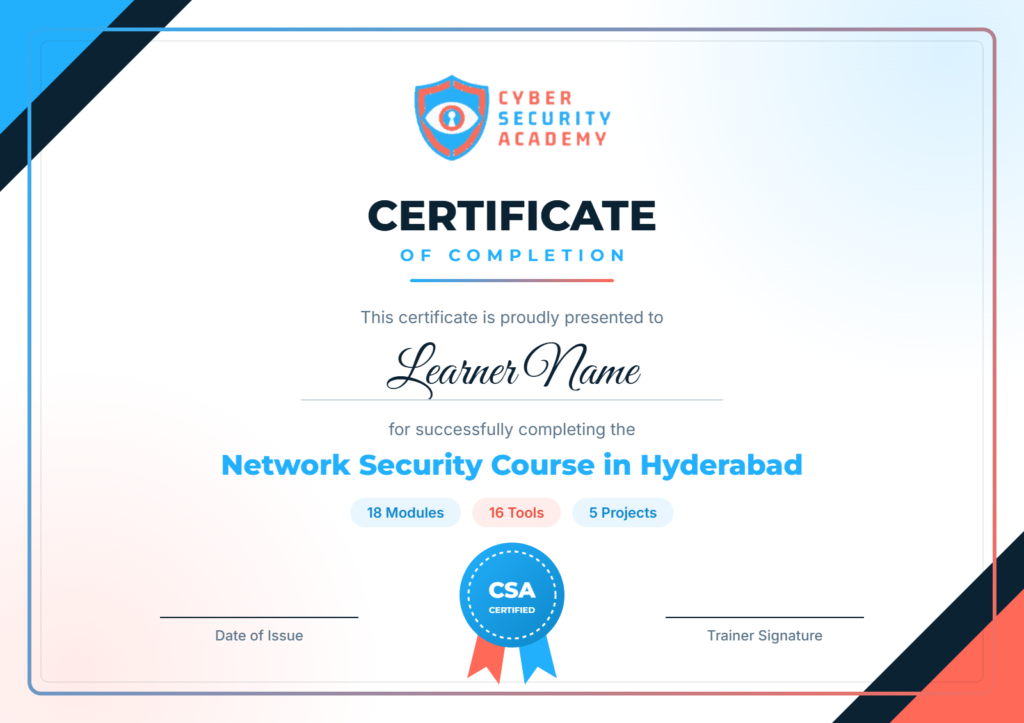 Sample · course completion certificate
Your trainer
 Lead Trainer
Mr. Praveen K
Lead trainer, network and infrastructure security.
10+ years of industry experience, teaching firewalls, intrusion detection, VPN, segmentation and secure network design from the perspective of someone who has built and defended production networks rather than only studied them.
Specialisations
Firewalls, IDS and IPS, VPN and remote access, segmentation, wireless security, network monitoring and Zero Trust design.
Teaching approach
Every concept lands in a lab the same session. No module ends without something configured and documented.
Mentorship
1:1 career mentorship and guidance on which certification path fits your background and budget.
Support
Doubt-clearing sessions, technical support and WhatsApp learning support between classes.
Learning modes and upcoming batches
Three ways to take the same 18-module syllabus.
Recorded course
Lifetime access ₹9,999✓ Fundamentals to advanced modules
✓ 1 capstone project included
✓ Tools walkthrough and certification guidance
✓ WhatsApp learning support
Classroom
Starts 2 November 2026 ₹32,000✓ 3 months, instructor-led practical training
✓ 5 documented projects, 16 tools
✓ 24/7 lab access
✓ Internship certificate and placement assistance
Live online
Weekday and weekend ₹25,000✓ Live interactive classes, same trainer
✓ Daily recordings and LMS access
✓ Hands-on labs and real projects
✓ Placement assistance and mock interviews
EMI and two-instalment payment options are available on classroom and online training.
Check us out before you enrol
We would rather you verify everything than take our word for it. Here is exactly how.
Sit in on a live class
Book a free demo and watch an actual session — the trainer, the pace, the lab setup and the batch you would join. Nothing is staged for visitors.
Read our Google reviews
Open our Google Business Profile and read what learners wrote there. Google reviews are tied to real accounts, which is why we point you to them rather than printing quotes here.
Read reviews on GoogleAsk to see a firewall rule set
Ask what a finished firewall build and audit looks like. If an institute cannot show you configured output, the labs are a line on a brochure.
Ask about lab access
Ask how many hours a day you can reach the lab and on whose infrastructure. Hands-on time is the difference between a certificate and a skill.
Ask whether you configure or watch
Ask if you build the firewall, tunnel and VLANs yourself or watch the trainer do it. That difference is the whole course.
Compare the syllabus
Our full 18-module syllabus is on this page. Compare it module by module — particularly on Zero Trust, cloud network security and network access control, which most syllabuses skip.
Network security salary in Hyderabad
Indicative market ranges by role and level. These are estimates, not offers.
Indicative annual range. Freshers, 0–2 years.
Indicative annual range. Freshers, 0–2 years.
Indicative annual range. Mid-level, 3–5 years.
Indicative annual range. Mid-level, 3–5 years.
Indicative annual range. Mid-level to senior.
Indicative annual range. Experienced, 8+ years.
Disclaimer. Salary figures shown are indicative market estimates and are not a guarantee of earnings. Actual compensation depends on experience, skills, certifications, employer and interview performance.
Career opportunities after the network security course
The roles this syllabus maps to, and what each one is actually accountable for.
Network Security Engineer
Builds and maintains firewalls, VPNs and network controls. Key skills: firewall rules, VPN, segmentation.
Network Security Analyst
Monitors and investigates network-layer threats. Key skills: traffic analysis, IDS, logs.
Firewall Administrator
Owns rule sets, change control and periodic rule review. Key skills: policy design, audit.
Network Administrator
Runs the network with security as a first-class concern. Key skills: routing, switching, hardening.
Security Operations Engineer
Maintains the tooling the SOC depends on. Key skills: sensors, logging, integrations.
Infrastructure Security Engineer
Secures servers, networks and hybrid connectivity. Key skills: architecture, hardening.
Cloud Network Security Engineer
Virtual networks, security groups and hybrid links. Key skills: cloud networking, IAM.
VPN and Remote Access Engineer
Secure remote connectivity at scale. Key skills: IPsec, TLS VPN, access policy.
NOC Engineer
Network operations with security monitoring built in. Key skills: monitoring, escalation.
Perimeter Security Engineer
External-facing controls and DMZ design. Key skills: firewalls, DMZ, exposure review.
Security Architect
Designs networks that resist attack by default. Key skills: Zero Trust, layered design.
Presales Security Consultant
Explains and designs network security solutions for clients. Key skills: breadth, communication.
Network security roadmap: beginner to job-ready
The order matters. Starting on exploitation tools before networking is the most common reason learners stall.
Networking
OSI, TCP/IP, addressing and subnetting. Before any security appliance.
• OSI and TCP/IP
• Subnetting
• Protocols and ports
Seeing the network
You cannot secure traffic you cannot read.
• Packet capture
• Protocol analysis
• Baselines
Perimeter controls
The devices you will be hired to configure and maintain.
• Firewalls
• IDS and IPS
• VPN
Internal controls
Limiting movement once someone is already inside.
• Segmentation and VLANs
• Wireless security
• 802.1X and NAC
Architecture and job ready
Design-level thinking, plus the projects and interview work.
• Zero Trust
• Cloud networking
• 5 documented projects
Network security vs cyber security vs ethical hacking
Three overlapping terms. This page is the first column. The other two have their own pages on this site.
Network security trends in Hyderabad in 2026
Three things specific to this city and this year.
Segmentation is the priority control
Flat networks are why a single compromised laptop becomes a company-wide incident. Segmentation and micro-segmentation projects are running across Hyderabad enterprises right now.
Zero Trust is a migration, not a product
Enterprises are moving from perimeter trust to identity-centric access. That transition needs engineers who understand both the old network and the new model.
The network moved to the cloud
Virtual networks, security groups and hybrid links are network security work with different names. Engineers who can do both on-premises and cloud are the scarce ones.
Common questions, answered directly
Is network security a good career in 2026? Yes, and it is more stable than most security niches. Every organisation runs a network, and firewalls, VPNs and segmentation need people to build and maintain them continuously.
Can a fresher get in? Yes. Network security roles hire from networking and IT support backgrounds regularly, and a documented firewall build carries real weight in an interview.
How do I start? OSI and TCP/IP, then addressing and subnetting, then traffic analysis, then firewalls, IDS, VPN and segmentation, then architecture. In that order.
Frequently asked questions
The twenty questions counsellors are asked most often, answered plainly.
What is the network security course in Hyderabad?
It is instructor-led training in securing networks — firewalls, IDS and IPS, VPNs, segmentation, wireless security, network authentication, monitoring and secure architecture. Cyber Security Academy delivers it as classroom training in Kukatpally and as live online batches across 18 modules over three months.
What is network security?
Network security is the set of controls that protect data as it moves across a network: firewalls that decide what traffic is allowed, IDS and IPS that detect and block attacks, VPNs that encrypt remote access, segmentation that limits how far an intruder can move, and monitoring that shows what is actually happening.
What is the network security course syllabus?
Eighteen modules: fundamentals, OSI and TCP/IP, IP addressing and subnetting, protocols and services, traffic analysis, firewalls, IDS and IPS, VPN, segmentation and VLANs, wireless security, network authentication and NAC, cryptography, network attacks and countermeasures, monitoring and logging, Zero Trust architecture, cloud network security, secure network design, and capstone assessments.
What is the network security course fee in Hyderabad?
Classroom training is ₹32,000, live online training is ₹25,000 and the recorded course is ₹9,999. EMI and two-instalment payment options are available. Certification exam fees are paid separately to the certifying body.
What is the network security course duration?
Three months. Classroom and live online batches follow the same 18-module syllabus, with weekday and weekend options so you can fit it around work.
Is the network security course suitable for beginners?
Yes. It starts with OSI and TCP/IP, IP addressing and subnetting before any security appliance is introduced. No prior networking or security experience is required.
Do I need CCNA before joining?
No. CCNA-level routing and switching knowledge helps and will let you move faster through the first four modules, but the course teaches networking from the ground up for learners who do not have it.
Is the network security course available online?
Yes. Live online batches run the same syllabus with the same trainer, with remote lab practice, recorded sessions and LMS access.
Is classroom training available in Hyderabad?
Yes, at Dr Atmaram Estates, Nizampet X Roads, near JNTU. Learners travel from KPHB, JNTU, Ameerpet, Madhapur, Hitech City and Gachibowli.
Will I configure a real firewall?
Yes. You design a rule set from scratch, apply least privilege and then audit and document every rule. Firewall configuration and rule review is the most common single task in a network security role.
Are IDS and IPS covered?
Yes, as their own module: the difference between detection and prevention, signature versus anomaly detection, rule tuning and false positive management, practised with Snort, Suricata and Zeek.
Is VPN configuration included?
Yes. IPsec and TLS VPNs, split tunnelling and remote access policy, with a lab building and testing a site-to-site tunnel using OpenVPN and WireGuard.
Is wireless security covered?
Yes. Wi-Fi protocols, WPA2 and WPA3, rogue access point detection and wireless hardening, with a full assessment lab.
Do you cover Zero Trust?
Yes, as its own module: Zero Trust principles, micro-segmentation, identity-centric access and continuous verification. It is the model most enterprises are migrating toward.
Is cloud network security included?
Yes. Virtual networks, security groups, cloud firewalls and hybrid connectivity, with a lab reviewing a cloud network configuration for exposure.
Are real projects included?
Five: a firewall build and rule audit, a network segmentation design, a traffic investigation, a wireless security assessment and a secure network architecture review. Each produces documented work.
What job roles can I apply for?
Network Security Engineer, Network Security Analyst, Firewall Administrator, Infrastructure Security Engineer, Cloud Network Security Engineer and NOC Engineer are the common entry points in the Hyderabad market.
What salary can I expect in Hyderabad?
Entry-level network security roles commonly advertise around ₹3.5–7 LPA, rising to ₹8–15 LPA at three to five years. These are indicative market ranges, not a guarantee.
Is placement assistance provided?
Yes: resume preparation built around your five documented projects, LinkedIn support, technical interview preparation, mock interviews and job application support. We do not guarantee placement.
Is there a job guarantee?
No. We do not guarantee placement or any salary outcome. What we provide is job-oriented training, five documented projects as a portfolio, interview preparation and placement assistance. The hiring decision belongs to the employer.
Ready to start your
network security career?
Sit in on a live session before you commit. You will see the curriculum, the trainer, the lab setup, the batch timings and how the projects work.
No obligation. Speak with a course counsellor and find out whether this programme is right for you.
Other courses at Cyber Security Academy
Visit or contact us
Our centre is at Dr Atmaram Estates, Nizampet X Roads, close to KPHB and JNTU.
 Find us on Google Maps
Dr Atmaram Estates, Nizampet X Roads
Open map →
Find us on Google Maps
Dr Atmaram Estates, Nizampet X Roads
Open map →