
Web Application Security Course in Hyderabad
OWASP Top 10, Burp Suite and API Testing
The web application security course in Hyderabad at Cyber Security Academy is three months of instructor-led training in testing web applications and APIs — the OWASP Top 10, broken access control, injection, cross-site scripting, authentication and session flaws, business logic abuse, API security and secure remediation. Eighteen modules, sixteen tools and five assessments, delivered as classroom batches in Kukatpally or live online.

Course snapshot
 Duration
3 months
Duration
3 months
 Mode
Classroom + live online
Mode
Classroom + live online
 Modules
18 modules, 16 tools
Modules
18 modules, 16 tools
 Level
Beginner to job-ready tester
Level
Beginner to job-ready tester
 Next batch
2 November 2026
Next batch
2 November 2026
 Location
Kukatpally, Hyderabad
Location
Kukatpally, Hyderabad
Web Application Security Course in Hyderabad — Quick Facts
Everything a prospective learner asks a counsellor in the first two minutes.
Course
Web Application Security Course in Hyderabad
Location
Kukatpally, Hyderabad
Training mode
Classroom + live online + recorded
Duration
3 months
Classroom fee
₹32,000
Online fee
₹25,000
Recorded course
₹9,999, lifetime access
Curriculum
18 modules, 16 tools, 5 assessments
Key areas
OWASP Top 10, Burp Suite, API testing, remediation
Certification prep
Burp Suite Certified Practitioner, eWPT, GWAPT
Next batch
2 November 2026
Prerequisites
None. HTTP and web fundamentals taught from scratch.
Placement support and career outcomes
What we do, stated plainly, and what we do not claim.
Resume and portfolio review
Your CV is rebuilt around the five assessments you actually wrote, using the terms application security hiring managers screen for.
Scenario-based interviews
Technical rounds on the OWASP Top 10, access control and session handling, plus the round every AppSec interview uses: walk me through a bug you found.
Job-role selection
Application testing, AppSec engineering and DevSecOps are different paths. We help you pick the one that fits how you work.
LinkedIn profile setup
Headline, skills, certifications and project section, so recruiter search surfaces you for application security roles.
Internship certificate
The classroom programme includes an internship certificate based on your completed capstone project work.
What we don't promise
No job guarantee, no guaranteed salary, no placement percentage. Any institute quoting those numbers cannot evidence them either.
Companies hiring application security professionals in Hyderabad
Product companies, global capability centres, consulting firms and specialist AppSec teams advertising application security roles in Hyderabad. We prepare you for their interview process. We are not claiming a hiring partnership with them.
Why choose this web application security course in Hyderabad
Every reason below is something you can verify before you pay.
Our web application security course in Hyderabad starts where testing actually starts: understanding an HTTP request. Then reconnaissance and mapping, then the OWASP Top 10 category by category, each demonstrated in a lab against a deliberately vulnerable application.
Eighteen modules cover broken access control, injection, cross-site scripting, authentication and session testing, CSRF and business logic, SSRF and server-side flaws, misconfiguration, API security, modern JavaScript frameworks, threat modelling, report writing and remediation.
It finishes with five assessments — a full OWASP Top 10 review, an access control and IDOR hunt, an API assessment, a business logic exercise and a threat model with remediation review.
Book a free demo class
See a real session before you commit — no obligation.
HTTP taught before payloads
You dissect a request and response by hand before touching a tool. Testers who skip this plateau at low-severity findings.
Burp Suite used, not shown
Proxy, Repeater, Intruder and Scanner across every module, the way testers actually work.
Access control gets its own module
Broken access control is the OWASP number one and the bug class scanners miss entirely.
Business logic testing
Workflow abuse, race conditions and price manipulation. No automation finds these, which is why they pay.
API security as a discipline
REST, tokens, BOLA and BFLA against the OWASP API Top 10. Far more surface, far less testing.
Modern frameworks covered
Single-page apps, JavaScript analysis, CORS and client-side storage. Most 2026 targets are SPAs.
Threat modelling included
STRIDE, data flow diagrams and trust boundaries. Finding flaws at design time is the cheapest security you can buy.
Report writing is assessed
Reproduction, impact, CVSS and remediation. Report quality decides both bounty payouts and job offers.
Remediation, not just discovery
Secure coding basics and framework defences, so you can talk to developers in their own terms.
Five documented assessments
OWASP review, IDOR hunt, API assessment, business logic exercise and a threat model review.
Classroom option in Kukatpally
In-person batches at our Nizampet X Roads centre, plus live online for everyone else.
EMI and instalment options
Classroom and online fees can be paid in EMI or two instalments.

Web Application Security Course Syllabus — 18 Modules
Eighteen modules that follow an application from a raw HTTP request to a submitted bug report — the topics, the lab and the outcome for each one.
Web Application Security Fundamentals
What you are protecting, and who is attacking it.
You will cover
✓ Application threat model
✓ Attack surface
✓ Security controls
✓ Responsible disclosure
Outcome: you can describe an application risk the way a security team writes it up.
How the Web Actually Works
You cannot test what you cannot describe.
You will cover
✓ HTTP requests and responses
✓ Status codes and headers
✓ Cookies and sessions
✓ Browser developer tools
Lab: dissect a full request and response by hand.
Setting Up the Testing Lab
Your environment, configured properly, once.
You will cover
✓ Kali Linux
✓ Burp Suite setup
✓ Proxy and certificates
✓ Deliberately vulnerable apps
Lab: intercept and modify your first live request.
Reconnaissance and Application Mapping
Everything before the first payload.
You will cover
✓ Subdomain discovery
✓ Content discovery
✓ Technology fingerprinting
✓ Endpoint mapping
Tools: Gobuster, ffuf, Amass, Wappalyzer.
OWASP Top 10 Overview
The framework every job description references.
You will cover
✓ The 2025 categories
✓ Why the list changed
✓ Mapping findings
✓ Prioritisation
Outcome: you can name and explain all ten, which interviews ask directly.
Broken Access Control
The number one category, and the one scanners miss.
You will cover
✓ Horizontal escalation
✓ Vertical escalation
✓ IDOR
✓ Forced browsing
Lab: find and evidence an IDOR in a training application.
Injection and SQL Injection
The classic, still found and still critical.
You will cover
✓ SQL injection types
✓ Blind and time-based
✓ Command injection
✓ Parameterisation as the fix
Tools: SQLmap plus manual payload testing.
Cross-Site Scripting
Three variants, each with a different fix.
You will cover
✓ Reflected XSS
✓ Stored XSS
✓ DOM-based XSS
✓ Output encoding and CSP
Lab: exploit and then remediate each variant.
Authentication Testing
Login, registration, reset and everything around them.
You will cover
✓ Credential handling
✓ Password policy
✓ Multi-factor bypass
✓ Account enumeration
Lab: a full authentication review with written findings.
Session Management Testing
How access is kept, and how it is stolen.
You will cover
✓ Session tokens
✓ Fixation and hijacking
✓ Cookie flags
✓ Logout and timeout
Outcome: you can explain SameSite, HttpOnly and Secure and why each matters.
CSRF and Business Logic Flaws
The bugs no scanner will ever find for you.
You will cover
✓ CSRF and defences
✓ Workflow abuse
✓ Race conditions
✓ Price and quantity manipulation
Outcome: business logic is where the highest-severity real findings live.
Server-Side Vulnerabilities
When the server fetches, parses or executes on your behalf.
You will cover
✓ SSRF
✓ File upload flaws
✓ Path traversal
✓ XXE and deserialisation
Lab: SSRF discovery and impact demonstration.
Security Misconfiguration
The category that costs nothing to fix and everything to ignore.
You will cover
✓ Default credentials
✓ Verbose errors
✓ Directory listing
✓ Security headers
Lab: a full header and configuration review.
API Security Testing
More surface than the front end ever shows.
You will cover
✓ REST fundamentals
✓ Authentication and tokens
✓ BOLA and BFLA
✓ Rate limiting
Lab: an API assessment against the OWASP API Top 10.
Client-Side and Modern Frameworks
Single-page apps, JavaScript and what moved to the browser.
You will cover
✓ JavaScript analysis
✓ CORS
✓ Client-side storage
✓ Framework-specific issues
Outcome: most applications you test in 2026 will be SPAs.
Threat Modelling and Design Review
Finding design flaws before a single line of code is written.
You will cover
✓ STRIDE
✓ Data flow diagrams
✓ Trust boundaries
✓ Design review
Outcome: the cheapest flaws to fix are the ones found before development starts.
Writing the Report
The finding is worth nothing until someone can act on it.
You will cover
✓ Reproduction steps
✓ Impact statement
✓ CVSS scoring
✓ Remediation guidance
Outcome: report quality decides both bounty payouts and job offers.
Secure Development and Remediation
Talking to developers in their own terms.
You will cover
✓ Secure coding basics
✓ Input validation
✓ Framework defences
✓ Retesting the fix
Outcome: the skill that turns a tester into an application security engineer.
Web application security tools you will use
Each tool, what it does, and where it shows up in the labs and projects.
Web application security skills you will learn
Twelve concrete capabilities you walk out with, aligned to what application security hiring managers screen for.
Burp Suite
Proxy, Repeater, Intruder and Scanner, used the way testers actually use them.
OWASP Top 10
All ten categories named, explained and demonstrated in a lab.
Access control testing
IDOR, horizontal and vertical escalation — the most-found real bug class.
SQL injection
Manual and automated testing, plus the parameterised fix.
Cross-site scripting
Reflected, stored and DOM-based, with encoding and CSP as remediation.
Authentication testing
Credential handling, MFA bypass, reset flows and account enumeration.
Session testing
Token handling, fixation, cookie flags and timeout behaviour.
Business logic testing
Workflow abuse and race conditions, which no scanner will find.
SSRF and server-side flaws
File upload, path traversal, XXE and deserialisation.
API security
REST, tokens, BOLA and BFLA against the OWASP API Top 10.
Threat modelling
STRIDE, data flow diagrams and trust boundary analysis at design time.
Report writing
Reproduction steps, impact, CVSS and remediation that a developer can act on.
Web application security assessments you will deliver
Five assessments, run against deliberately vulnerable applications. Each one ends in a written report you can walk an interviewer through.
Full OWASP Top 10 assessment
Access control and IDOR hunt
API security assessment
Business logic testing exercise
Threat model and remediation review
Who can join this web application security course?
Suitable for a wide range of learners. No prior security experience is required to start.
Freshers and students
Start from how HTTP works. No prior security or development experience needed.
Developers
Understand the findings that land on your backlog, and stop writing them.
Testers and QA engineers
Functional testing instincts map almost directly onto security testing.
Penetration testers
Add application depth to a generalist testing skill set.
SOC analysts
Understand the web attacks behind the alerts you triage.
Security consultants
Add application depth to a broader advisory skill set.
Career switchers
A structured path into application security, the best-paid defensive niche.
Future application security testers
Ready to move from using web applications to breaking and fixing them? This is the on-ramp.
OWASP · Burp Suite · API · RemediationWhich certification suits an application security tester?
Certifications help. A portfolio of written findings helps more. Here is the sequence that fits an application security career.
Burp Suite Certified Practitioner

Web application testing credentials
Application security is one of the few areas where a portfolio genuinely outweighs certificates. Five written assessments and a Burp Suite Practitioner pass will beat a stack of multiple-choice credentials in almost any interview. PortSwigger's Web Security Academy is free and we point you to it from module 5 onward. Certification names, formats and prices change, so verify with the provider before booking.
Certification path we prepare you for
What you receive on completion
On completing the programme you receive a Cyber Security Academy course completion certificate — a record of the modules you finished and the assessments you delivered. It is separate from any vendor certification, which is issued by the certifying body.
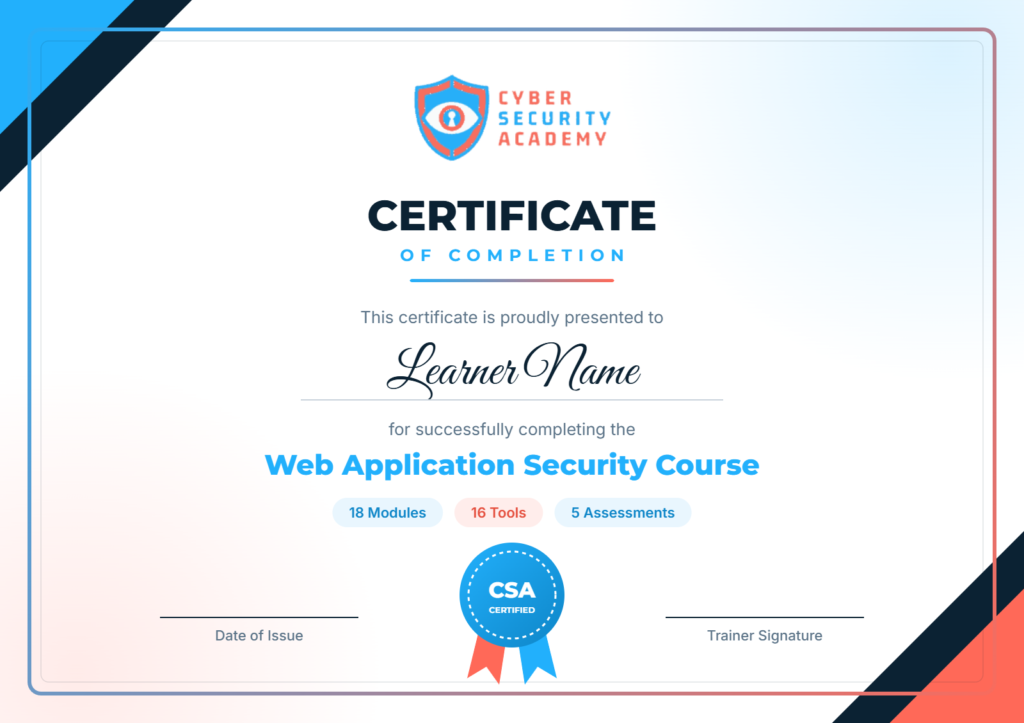 Sample · course completion certificate
Your trainer
 Lead Trainer
Mr. Praveen K
Lead trainer, application and API security.
10+ years of industry experience, teaching web and API testing, OWASP methodology and report writing from the perspective of someone who has assessed production applications rather than only studied them.
Specialisations
Web application testing, API security, access control and business logic testing, Burp Suite, and professional reporting.
Teaching approach
Every concept lands in a lab the same session. No module ends without a vulnerability found and written up.
Mentorship
1:1 career mentorship and guidance on which certification path fits your background and budget.
Support
Doubt-clearing sessions, technical support and WhatsApp learning support between classes.
Learning modes and upcoming batches
Three ways to take the same 18-module syllabus.
Recorded course
Lifetime access ₹9,999✓ Fundamentals to advanced modules
✓ 1 capstone project included
✓ Tools walkthrough and certification guidance
✓ WhatsApp learning support
Classroom
Starts 2 November 2026 ₹32,000✓ 3 months, instructor-led practical training
✓ 5 documented projects, 16 tools
✓ 24/7 lab access
✓ Internship certificate and placement assistance
Live online
Weekday and weekend ₹25,000✓ Live interactive classes, same trainer
✓ Daily recordings and LMS access
✓ Hands-on labs and real projects
✓ Placement assistance and mock interviews
EMI and two-instalment payment options are available on classroom and online training.
Check us out before you enrol
We would rather you verify everything than take our word for it. Here is exactly how.
Sit in on a live class
Book a free demo and watch an actual session — the trainer, the pace, the lab setup and the batch you would join. Nothing is staged for visitors.
Read our Google reviews
Open our Google Business Profile and read what learners wrote there. Google reviews are tied to real accounts, which is why we point you to them rather than printing quotes here.
Read reviews on GoogleAsk to see a real finding
Ask what a finished vulnerability report looks like. In this field the report is the product. If an institute cannot show you one, the labs are a line on a brochure.
Ask about lab access
Ask how many hours a day you can reach the lab and on whose infrastructure. Hands-on time is the difference between a certificate and a skill.
Ask whether you exploit or watch
Ask if you find and exploit the bugs yourself in Burp Suite or watch the trainer do it. That difference is the whole course.
Compare the syllabus
Our full 18-module syllabus is on this page. Compare it module by module — particularly on business logic, API security and threat modelling, which most syllabuses skip.
Application security salary in Hyderabad
Indicative market ranges by role and level. These are estimates, not offers.
Indicative annual range. Freshers, 0–2 years.
Indicative annual range. Freshers to mid-level.
Indicative annual range. Mid-level, 3–5 years.
Indicative annual range. Experienced, 5+ years.
Indicative annual range. Mid-level to senior.
Indicative annual range. Mid-level to senior.
Disclaimer. Salary figures shown are indicative market estimates and are not a guarantee of earnings. Actual compensation depends on experience, skills, certifications, employer and interview performance.
Career opportunities after the web application security course
The roles this syllabus maps to, and what each one is actually accountable for.
Web Application Security Tester
Tests applications against OWASP categories. Key skills: Burp Suite, access control, reporting.
Application Security Analyst
Works with developers to reduce application risk. Key skills: triage, secure coding, communication.
Application Security Engineer
Builds security into the development lifecycle. Key skills: SAST, DAST, framework defences.
VAPT Analyst
Combined vulnerability assessment and testing delivery. Key skills: Burp Suite, CVSS, reporting.
Penetration Tester
Broader assessment work including applications. Key skills: methodology, exploitation, reporting.
API Security Tester
Authentication, authorisation and object-level access on APIs. Key skills: REST, tokens, BOLA.
Secure Design Reviewer
Finds flaws in architecture before build. Key skills: STRIDE, trust boundaries, risk.
Product Security Engineer
Owns security for a specific product. Key skills: threat modelling, review, remediation.
DevSecOps Engineer
Security automation inside the pipeline. Key skills: CI/CD, SAST, DAST, policy.
Secure Code Reviewer
Reads code for security defects. Key skills: language fluency, common flaw patterns.
Security Consultant
Client-facing application assessment and advisory. Key skills: breadth, communication.
Threat Modelling Specialist
Finds design flaws before code is written. Key skills: architecture, STRIDE, risk.
Web application security roadmap: beginner to job-ready
The order matters. Starting on exploitation tools before networking is the most common reason learners stall.
How the web works
HTTP, sessions and the browser. Before any payload.
• Requests and responses
• Cookies and sessions
• Lab setup
Mapping
Finding everything the application exposes.
• Subdomain discovery
• Content discovery
• Fingerprinting
The OWASP Top 10
Category by category, each demonstrated in a lab.
• Access control
• Injection and XSS
• Auth and sessions
Beyond the checklist
Where the high-value findings actually live.
• Business logic
• SSRF and server-side
• API security
Report and get hired
The write-up, the design review and the remediation conversation.
• Threat modelling
• Report writing
• 5 assessments
Web application security vs ethical hacking vs penetration testing
Three overlapping courses on this site. This page is the first column.
Web application security trends in 2026
Three things specific to this city and this year.
Access control is the top category
Broken access control sits at number one in the OWASP list, and it is the class automated scanning handles worst. Testers who can find IDOR and privilege escalation reliably stay in demand.
APIs are under-tested
Every mobile app and single-page application is an API client. That surface is far larger than the web front end and gets a fraction of the testing attention.
AppSec pays above the security average
Application security engineers command a premium in Hyderabad because the role needs both testing skill and enough development fluency to explain the fix.
Common questions, answered directly
Is application security a good career in 2026? Yes, and it pays above the security average. Every company ships software, and finding flaws before release is cheaper than responding to a breach after.
Can a fresher get in? Yes. AppSec hires on demonstrated finding ability, so five written assessments and a clean bug report carry real weight even without experience.
How do I start? HTTP fundamentals, then Burp Suite, then the OWASP Top 10 category by category, then business logic and APIs, then reporting. In that order.
Frequently asked questions
The twenty questions counsellors are asked most often, answered plainly.
What is the web application security course in Hyderabad?
It is instructor-led training in testing web applications and APIs for security flaws — the OWASP Top 10, access control, injection, XSS, authentication and session testing, business logic, SSRF, API security and threat modelling. Eighteen modules over three months, classroom in Kukatpally or live online.
What is web application security?
Web application security is the practice of finding and fixing flaws in websites, web applications and APIs before an attacker exploits them: broken access control, injection, cross-site scripting, authentication weaknesses, misconfiguration and business logic abuse.
What is the syllabus?
Eighteen modules: fundamentals, how the web works, lab setup, reconnaissance and mapping, the OWASP Top 10, broken access control, injection and SQL injection, cross-site scripting, authentication testing, session management, CSRF and business logic, server-side vulnerabilities, security misconfiguration, API security, client-side and modern frameworks, threat modelling, report writing, and secure development and remediation.
What is the course fee?
Classroom training is ₹32,000, live online training is ₹25,000 and the recorded course is ₹9,999. EMI and two-instalment payment options are available.
What is the course duration?
Three months. Classroom and live online batches follow the same 18-module syllabus, with weekday and weekend options.
Do I need to know how to code?
No. The course starts with how HTTP works and builds from there. Coding experience helps in the secure development module, but developers, testers and complete beginners all start from the same point.
Do you teach Burp Suite?
Yes, throughout. Proxy, Repeater, Intruder and Scanner, used the way testers actually use them rather than demonstrated once. Burp is the tool named in most application security job descriptions.
Is the OWASP Top 10 covered?
Yes, with an overview module and then dedicated modules on the categories that matter most in practice: broken access control, injection, cross-site scripting, authentication and session failures, security misconfiguration and server-side request forgery.
Is API security testing included?
Yes, as its own module covering REST fundamentals, tokens, BOLA and BFLA against the OWASP API Top 10. APIs expose far more surface than the front end and are tested far less often.
Is bug bounty hunting covered?
The vulnerability knowledge here applies directly to bounty hunting, but the researcher workflow — platforms, scope, recon automation, duplicate strategy and triager-facing reports — has its own dedicated programme. See our bug bounty course.
Is threat modelling covered?
Yes, as its own module: STRIDE, data flow diagrams and trust boundaries. Finding a design flaw before development starts is far cheaper than finding it in a penetration test, and it is the skill that distinguishes an application security engineer from a tester.
Is business logic testing covered?
Yes. Workflow abuse, race conditions and price or quantity manipulation. No scanner finds these, which is exactly why they pay well in both bounties and salaries.
Is report writing covered?
Yes, as its own module. Reproduction steps, impact statement, CVSS scoring and remediation guidance a developer can act on. Report quality decides both bounty payouts and job offers.
How is this different from the ethical hacking course?
Ethical hacking covers many attack surfaces broadly — network, wireless, mobile, IoT, social engineering. This course goes deep on one surface: web applications and APIs. If you want application security specifically, this is the focused path.
Are real projects included?
Five: a full OWASP Top 10 assessment, an access control and IDOR hunt, an API security assessment, a business logic testing exercise and a threat model with remediation review.
What job roles can I apply for?
Web Application Security Tester, Application Security Analyst, VAPT Analyst, API Security Tester, Penetration Tester and, with development experience, Application Security Engineer.
What salary can I expect in Hyderabad?
Entry-level application security testing roles commonly advertise around ₹4–7 LPA, rising to ₹10–18 LPA at three to five years. Application security is among the better-paid defensive niches. These are indicative market ranges, not a guarantee.
Is the training available online?
Yes. Live online batches run the same syllabus with the same trainer, with remote lab access, recorded sessions and LMS materials.
Is placement assistance provided?
Yes: resume preparation built around your five assessments, LinkedIn support, technical interview preparation, mock interviews and job application support. We do not guarantee placement.
Is there a job guarantee?
No. We do not guarantee placement or any salary outcome. What we provide is job-oriented training, five documented assessments as a portfolio, interview preparation and placement assistance. The hiring decision belongs to the employer.
Ready to start your
application security career?
Sit in on a live session before you commit. You will see the curriculum, the trainer, the lab setup, the batch timings and how the projects work.
No obligation. Speak with a course counsellor and find out whether this programme is right for you.
Other courses at Cyber Security Academy
Visit or contact us
Our centre is at Dr Atmaram Estates, Nizampet X Roads, close to KPHB and JNTU.
 Find us on Google Maps
Dr Atmaram Estates, Nizampet X Roads
Open map →
Find us on Google Maps
Dr Atmaram Estates, Nizampet X Roads
Open map →