
Bug Bounty Course
Recon, Hunting, Reporting
This bug bounty course teaches the full workflow of an independent security researcher: choosing a programme on HackerOne or Bugcrowd, reading scope correctly, running reconnaissance at scale, finding valid vulnerabilities, avoiding duplicates and writing a report a triager accepts. Sixteen modules over three months, live online anywhere in India or classroom in Hyderabad.

Course snapshot
 Duration
3 months
Duration
3 months
 Mode
Classroom + live online
Mode
Classroom + live online
 Modules
16 modules, 16 tools
Modules
16 modules, 16 tools
 Level
Beginner to independent hunter
Level
Beginner to independent hunter
 Next batch
2 November 2026
Next batch
2 November 2026
 Location
Kukatpally, Hyderabad
Location
Kukatpally, Hyderabad
Bug Bounty Course — Quick Facts
Everything a prospective learner asks a counsellor in the first two minutes.
Course
Bug Bounty Course
Location
Live online across India, or classroom in Hyderabad
Training mode
Classroom + live online + recorded
Duration
3 months
Classroom fee
₹32,000
Online fee
₹25,000
Recorded course
₹9,999, lifetime access
Curriculum
16 modules, 16 tools, 5 exercises
Key areas
Platforms, scope, recon automation, duplicates, reporting
Certification prep
Burp Suite Certified Practitioner
Next batch
2 November 2026
Prerequisites
None. HTTP fundamentals taught from scratch.
Placement support and career outcomes
What we do, stated plainly, and what we do not claim.
Resume and profile review
Your CV and platform profile are built around the findings and reports you actually produced, using the terms AppSec hiring managers screen for.
Scenario-based interviews
Technical rounds on access control, authentication and business logic, plus the round every AppSec interview uses: walk me through a bug you found.
Turning hunting into hiring
Bounty findings are verifiable evidence. We help you present them so they read as professional experience.
LinkedIn profile setup
Headline, skills, certifications and project section, so recruiter search surfaces you for application security roles.
Internship certificate
The classroom programme includes an internship certificate based on your completed capstone project work.
What we don't promise
No job guarantee, no guaranteed salary, no placement percentage. Any institute quoting those numbers cannot evidence them either.
Where bug bounty experience gets you hired
Product companies, global capability centres, consulting firms and platform triage teams hire people with demonstrated finding ability. A disclosed report is evidence they can verify. We are not claiming a hiring partnership with these companies.
Why choose this bug bounty course
Every reason below is something you can verify before you pay.
Our bug bounty course starts with the parts most tutorials skip: how programmes work, how triage decides your payout, and how to read a scope so you never waste a week on an out-of-scope asset.
Then reconnaissance, because most bounties are won on attack surface rather than exotic exploits. You build a pipeline that monitors targets continuously and alerts you when new subdomains appear.
Then the bug classes that actually get paid: broken access control and IDOR, account takeover, business logic and race conditions, SSRF, and API and GraphQL targets where competition is thinner. It ends with a report that is reviewed before you submit anything to a real programme.
Book a free demo class
See a real session before you commit — no obligation.
Scope discipline first
Reading scope properly is the single most common reason reports get rejected. It is module 3, before any hunting.
Recon automation, not manual poking
You build a pipeline that monitors targets continuously and alerts you to new attack surface.
Duplicate strategy as a module
Valid bugs get closed as duplicates every day. Target selection and timing are taught deliberately.
The bug classes that pay
Access control, account takeover, business logic and SSRF each get their own module.
Your report is reviewed
You write a submission-quality report and have it marked before you send one to a real programme.
APIs and GraphQL
Less-hunted surface with fewer competitors. BOLA, BFLA, introspection and mobile backends.
Legal boundaries taught properly
Programme terms are your authorisation. A full module covers where that protection ends.
Platforms compared
HackerOne, Bugcrowd, Intigriti and YesWeHack, plus how private invites and VDPs differ.
Honest about earnings
We tell you that most beginners earn nothing for months. No institute selling you a dream will say that.
Built to get you hired
Most successful hunters use bounties to land an AppSec job rather than replace a salary. We optimise for that.
Classroom or live online
Classroom batches at our Nizampet X Roads centre, live online anywhere in India.
EMI and instalment options
Classroom and online fees can be paid in EMI or two instalments.

Bug Bounty Course Syllabus — 16 Modules
Sixteen modules that follow a hunt from picking a programme to a paid report — the topics, the lab and the outcome for each one.
How Bug Bounty Actually Works
The business model, before the techniques.
You will cover
✓ VDP vs paid programmes
✓ Triage process
✓ Reputation and signal
✓ Realistic earnings
Outcome: you understand what you are signing up for, including the parts nobody advertises.
Platforms and Programme Selection
Picking the wrong programme wastes months.
You will cover
✓ HackerOne
✓ Bugcrowd
✓ Intigriti and YesWeHack
✓ Private invitations
Lab: evaluate five live programmes and justify which you would hunt.
Reading Scope Properly
The single most common reason reports get rejected.
You will cover
✓ In-scope vs out-of-scope
✓ Asset types
✓ Prohibited testing
✓ Safe harbour terms
Outcome: you never submit an out-of-scope finding again.
Legal and Ethical Boundaries
What authorisation means when the target is a stranger.
You will cover
✓ Programme terms as authorisation
✓ Data handling
✓ Denial of service rules
✓ Responsible disclosure
Outcome: the boundary between researcher and defendant.
Recon Fundamentals
Attack surface is where bounties are actually won.
You will cover
✓ Subdomain enumeration
✓ DNS and certificate transparency
✓ ASN and IP ranges
✓ Wayback and archives
Tools: Amass, subfinder, crt.sh, waybackurls.
Recon at Scale and Automation
Hunters who automate cover more ground than hunters who do not.
You will cover
✓ Pipeline design
✓ Continuous monitoring
✓ Change detection
✓ Notification workflows
Lab: build a monitoring pipeline that alerts you to new subdomains.
Content and Endpoint Discovery
Finding what was never meant to be found.
You will cover
✓ Directory brute forcing
✓ JavaScript endpoint mining
✓ Parameter discovery
✓ Wordlist strategy
Tools: ffuf, Gobuster, LinkFinder, Arjun.
Broken Access Control and IDOR
The highest-yield bug class on most programmes.
You will cover
✓ Object reference tampering
✓ Horizontal escalation
✓ Vertical escalation
✓ Multi-account testing
Lab: two accounts, one application, find the boundary failure.
Authentication and Account Takeover
The findings that get triaged fastest and paid best.
You will cover
✓ Reset token flaws
✓ OAuth misconfiguration
✓ MFA bypass
✓ Session fixation
Outcome: account takeover is near-universally accepted as high severity.
Business Logic and Race Conditions
What automation will never find for you.
You will cover
✓ Workflow abuse
✓ Price and quantity manipulation
✓ Race conditions
✓ Sequence bypass
Tools: Burp Repeater, Turbo Intruder.
SSRF and Server-Side Findings
High-impact bugs when you can prove the impact.
You will cover
✓ SSRF discovery
✓ Internal service access
✓ Cloud metadata risks
✓ Blind SSRF confirmation
Lab: discover, confirm and safely evidence an SSRF.
XSS, CSRF and Client-Side Bugs
Common, often duplicated, still worth knowing well.
You will cover
✓ Reflected, stored and DOM XSS
✓ CSRF and defences
✓ postMessage and CORS
✓ When these are worth reporting
Outcome: you learn which of these are usually duplicates.
API and Mobile Targets
Where the competition is thinner.
You will cover
✓ REST and GraphQL
✓ BOLA and BFLA
✓ Mobile app traffic interception
✓ Hardcoded secrets
Lab: intercept a mobile app and test its backing API.
Duplicate Avoidance and Triage Reality
Why good bugs still get closed as duplicate.
You will cover
✓ Why duplicates happen
✓ Choosing less-hunted surface
✓ Timing and programme age
✓ Reading disclosed reports
Outcome: the strategy that decides whether hunting pays.
Writing Reports Triagers Accept
The finding is worth nothing until a triager can reproduce it.
You will cover
✓ Reproduction steps
✓ Impact statement
✓ CVSS scoring
✓ Evidence without over-testing
Lab: write a submission-quality report and have it reviewed.
Building a Sustainable Hunting Practice
Turning sporadic finds into a repeatable habit.
You will cover
✓ Time management
✓ Target rotation
✓ Collaboration and disclosure
✓ Using bounty work to get hired
Outcome: most successful hunters use bounties to land a job, not replace one.
Bug bounty tools you will use
Each tool, what it does, and where it shows up in the labs and projects.
Bug bounty skills you will learn
Twelve concrete capabilities you walk out with, aligned to what actually gets reports accepted.
Programme selection
Reading scope, terms and payout history to pick targets worth your time.
Scope discipline
Knowing exactly what is in scope, and never submitting outside it.
Subdomain enumeration
Passive and active asset discovery across a large attack surface.
Recon automation
Pipelines that monitor targets continuously instead of once.
Endpoint discovery
Directory fuzzing, JavaScript mining and hidden parameter discovery.
Access control testing
IDOR and privilege escalation, the highest-yield bug class.
Account takeover
Reset flows, OAuth misconfiguration and MFA bypass.
Business logic testing
Workflow abuse and race conditions that no scanner finds.
SSRF exploitation
Discovery, confirmation and safe impact evidence.
API and GraphQL testing
BOLA, BFLA and introspection abuse on less-hunted surface.
Duplicate avoidance
Choosing surface and timing so your valid bug is not the fifth one filed.
Report writing
Reproduction, impact and CVSS in the format triagers accept quickly.
Practical exercises you will complete
Five exercises, run against training targets and live programme scopes. The last one is a report reviewed before you ever submit to a real programme.
Programme evaluation exercise
Full recon pipeline build
Access control and account takeover hunt
Business logic and race condition exercise
Submission-quality report
Who can join this bug bounty course?
Suitable for a wide range of learners. No prior security experience is required to start.
Students and freshers
Bug bounty is one of the few security paths with no gatekeeper. You need skill and a laptop.
Web application testers
Add the independent researcher workflow to skills you already have.
Developers
Understanding how your applications get broken makes you a better engineer, and pays.
Ethical hacking learners
Move from lab exercises to live targets with real programme rules.
Testers and QA engineers
Systematic exploration is exactly the habit bounty hunting rewards.
Working professionals
A weekend practice that builds a public portfolio while you keep your job.
Career switchers
A disclosed report is evidence anyone can verify, which is rare in security hiring.
Future bug bounty hunters
Ready to move from watching hunting videos to running a real workflow on live scope? This is the on-ramp.
Recon · Scope · Hunt · ReportDo you need a certification to hunt bugs?
No. Bug bounty is the one security path where nobody checks your credentials. But if you want the hunting skill to become a job, one credential helps.
No certification required

Burp Suite Certified Practitioner
Bug bounty is genuinely open. No programme asks for a degree or a certificate before accepting your report, and a public platform profile is verifiable in a way most security credentials are not. If your goal is a job rather than bounty income, Burp Suite Certified Practitioner pairs well with a disclosed report, and PortSwigger's Web Security Academy is free to prepare with. Certification names, formats and prices change, so verify with the provider before booking.
Certification path we prepare you for
What you receive on completion
On completing the programme you receive a Cyber Security Academy course completion certificate — a record of the modules you finished and the exercises you completed. It carries no weight with bounty platforms, and we would not pretend otherwise. Your reports are the credential that matters.
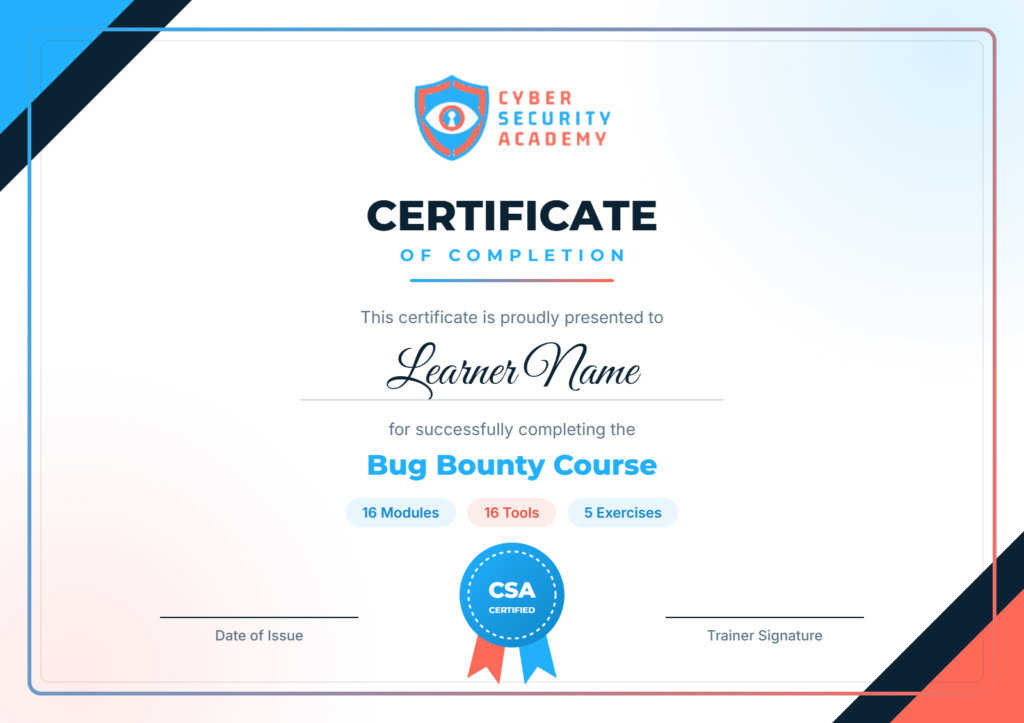 Sample · course completion certificate
Your trainer
 Lead Trainer
Mr. Praveen K
Lead trainer, application security and vulnerability research.
10+ years of industry experience, teaching reconnaissance, application testing and report writing from the perspective of someone who has assessed production systems rather than only studied them.
Specialisations
Reconnaissance and automation, access control and business logic testing, API and GraphQL security, Burp Suite, and report writing.
Teaching approach
Every concept lands in a lab the same session. No module ends without something found, confirmed and written up.
Mentorship
1:1 career mentorship and guidance on which certification path fits your background and budget.
Support
Doubt-clearing sessions, technical support and WhatsApp learning support between classes.
Learning modes and upcoming batches
Three ways to take the same 16-module syllabus.
Recorded course
Lifetime access ₹9,999✓ Fundamentals to advanced modules
✓ 1 capstone project included
✓ Tools walkthrough and certification guidance
✓ WhatsApp learning support
Classroom
Starts 2 November 2026 ₹32,000✓ 3 months, instructor-led practical training
✓ 5 documented projects, 16 tools
✓ 24/7 lab access
✓ Internship certificate and placement assistance
Live online
Weekday and weekend ₹25,000✓ Live interactive classes, same trainer
✓ Daily recordings and LMS access
✓ Hands-on labs and real projects
✓ Placement assistance and mock interviews
EMI and two-instalment payment options are available on classroom and online training.
Check us out before you enrol
We would rather you verify everything than take our word for it. Here is exactly how.
Sit in on a live class
Book a free demo and watch an actual session — the trainer, the pace, the lab setup and the batch you would join. Nothing is staged for visitors.
Read our Google reviews
Open our Google Business Profile and read what learners wrote there. Google reviews are tied to real accounts, which is why we point you to them rather than printing quotes here.
Read reviews on GoogleAsk to see a real report
Ask what a submission-quality report looks like. In bounty hunting the report is the product. If an institute cannot show you one, the course is theory.
Ask about lab access
Ask how many hours a day you can reach the lab and on whose infrastructure. Hands-on time is the difference between a certificate and a skill.
Ask about earnings claims
Ask any institute what their students actually earn from bounties. If the answer is a big number with no evidence behind it, walk away.
Compare the syllabus
Our full 16-module syllabus is on this page. Compare it module by module — particularly on scope reading, duplicate strategy and recon automation, which most bounty courses skip entirely.
Bug bounty earnings and application security salaries
Bounty income is not a salary. The employed roles below are what most hunters actually convert into.
Indicative annual range. Highly variable, not a salary.
Indicative annual range. Freshers, 0–2 years.
Indicative annual range. Freshers to mid-level.
Indicative annual range. Mid-level, 3–5 years.
Indicative annual range. Mid-level, 3–5 years.
Indicative annual range. Experienced, 5+ years.
Disclaimer. Salary figures shown are indicative market estimates and are not a guarantee of earnings. Actual compensation depends on experience, skills, certifications, employer and interview performance.
Career opportunities after the bug bounty course
The roles this syllabus maps to, and what each one is actually accountable for.
Bug Bounty Hunter
Independent research on public and private programmes. Key skills: recon, access control, reporting.
Web Application Security Tester
Application testing inside a company. Key skills: Burp Suite, OWASP, reporting.
Application Security Analyst
Triage and remediation alongside developers. Key skills: risk assessment, communication.
Penetration Tester
Scoped client engagements. Key skills: methodology, exploitation, documentation.
VAPT Analyst
Combined assessment and testing delivery. Key skills: Burp Suite, CVSS, reporting.
API Security Tester
REST and GraphQL testing. Key skills: BOLA, BFLA, token analysis.
Security Researcher
Deeper research on products or protocols. Key skills: persistence, writing, disclosure.
Triage Analyst
Works on the platform side reviewing incoming reports. Key skills: reproduction, severity, communication.
Product Security Engineer
Owns security for a product. Key skills: threat modelling, review, remediation.
Offensive Security Analyst
Supports authorised offensive testing programmes. Key skills: tooling, evidence.
Security Consultant
Client-facing assessment and advisory. Key skills: breadth, communication.
Red Team Operator
Adversary simulation. Key skills: evasion, tradecraft, attack paths.
Bug bounty roadmap: beginner to first accepted report
The order matters. Starting on exploitation tools before networking is the most common reason learners stall.
Understand the game
Platforms, triage, scope and the legal boundary. Before any hunting.
• Programme types
• Scope reading
• Legal limits
Build the recon engine
Attack surface is where bounties are won.
• Subdomain enumeration
• Automation pipeline
• Endpoint discovery
Hunt what pays
The bug classes triagers accept and reward.
• Access control and IDOR
• Account takeover
• Business logic
Go where others are not
Thinner competition means fewer duplicates.
• SSRF
• APIs and GraphQL
• Mobile backends
Report and convert
The write-up, and turning findings into a job.
• Triager-ready reports
• Duplicate strategy
• Portfolio to interview
Bug bounty vs web application security vs penetration testing
Three overlapping courses on this site. This page is the first column.
The honest state of bug bounty in 2026
Three things specific to this city and this year.
The easy surface is gone
Public programmes have been hunted for years. Reflected XSS on a main domain is almost always a duplicate. The findings that pay now come from deeper recon and less obvious assets.
Access control still pays
IDOR and privilege escalation remain the most rewarded classes because they require two accounts, patience and human judgement. Automation does not find them.
Most hunters convert to jobs
The realistic outcome for the large majority is not full-time bounty income. It is an application security or testing job won on the strength of verifiable findings.
Common questions, answered directly
Is bug bounty worth it in 2026? As a skill builder and portfolio, yes. As a primary income, for most people no. Competition is high and duplicates are common. Go in expecting to learn and to build evidence, and treat any payment as a bonus.
Can a complete beginner start? Yes. There is no gatekeeper — no degree, no certificate, no employer required. What you need is the workflow, and the patience to apply it for months rather than weeks.
How do I start? Learn how programmes and scope work, build a recon pipeline, focus on access control and account takeover, avoid crowded surface, and write reports a triager can reproduce in two minutes. In that order.
Frequently asked questions
The twenty questions counsellors are asked most often, answered plainly.
What is a bug bounty course?
It is training in the full workflow of an independent security researcher: choosing a programme, reading scope correctly, running reconnaissance at scale, finding valid vulnerabilities, avoiding duplicates and writing a report a triager accepts. Sixteen modules over three months, live online or classroom in Hyderabad.
What is bug bounty hunting?
Bug bounty hunting is finding and reporting security vulnerabilities in a company's systems under a published programme that authorises the testing. Platforms such as HackerOne and Bugcrowd host these programmes. Valid, in-scope, non-duplicate findings may earn a reward.
Can I actually earn money from bug bounty?
Some people do. Most beginners earn nothing for their first few months, and income remains irregular even for experienced hunters. Duplicates, out-of-scope submissions and informative-only closures are normal. Treat it as a skill-building and portfolio activity that may pay, not as a salary replacement. We would rather say that plainly than sell you a dream.
How long before I find my first valid bug?
There is no honest answer to that. It depends on the hours you put in, the targets you choose and how well you read scope. What this course does is remove the avoidable failures: bad programme choice, out-of-scope reports, thin recon and reports triagers cannot reproduce.
Do I need programming knowledge?
No. You need to understand how HTTP works, which is taught in the course. Reading JavaScript helps for endpoint discovery and scripting helps for automation, but neither is a prerequisite.
Which platforms do you cover?
HackerOne, Bugcrowd, Intigriti and YesWeHack, plus how private invitations work and how vulnerability disclosure programmes differ from paid ones.
Why do valid bugs get closed as duplicate?
Because popular programmes have hundreds of hunters covering the same obvious surface. Duplicate avoidance is a strategy module in this course: choosing less-hunted assets, watching programme age, monitoring for newly added scope and reading disclosed reports.
Is reconnaissance really that important?
Yes. Most bounties are won on attack surface, not on exotic exploits. Two modules cover recon fundamentals and recon automation, including building a pipeline that alerts you when a target adds a new subdomain.
What bug classes pay best?
Broken access control and IDOR, account takeover, business logic flaws and SSRF where impact can be proven. Each of these has its own module. Reflected XSS and CSRF are covered too, with an honest note on how often they are duplicates.
Is report writing covered?
Yes, as its own module, and you write a submission-quality report that is reviewed before you send anything to a real programme. Reproduction steps, impact statement, CVSS score and evidence gathered without over-testing.
Is bug bounty legal?
Yes, when you stay inside a published programme scope. The programme terms are your authorisation. Testing outside scope, ignoring prohibited techniques or mishandling data removes that protection. A full module covers the legal and ethical boundaries.
How is this different from the web application security course?
The web application security course teaches you to test an application in depth against the OWASP Top 10, inside a company, with remediation. This course teaches the independent researcher workflow: platforms, scope, recon at scale, duplicate strategy and triager-facing reports. The vulnerability knowledge overlaps; the process is completely different.
Should I take this or the ethical hacking course first?
If you are new to security, ethical hacking or web application security gives you a broader base. If you already understand web applications and want the hunting workflow, start here.
Are APIs and mobile targets covered?
Yes. REST and GraphQL, BOLA and BFLA, mobile traffic interception and hardcoded secrets. These surfaces have fewer hunters on them, which is precisely why they are worth learning.
What is the course fee?
Classroom training is ₹32,000, live online training is ₹25,000 and the recorded course is ₹9,999. EMI and two-instalment payment options are available.
What is the course duration?
Three months. Classroom and live online batches follow the same 16-module syllabus, with weekday and weekend options.
Can bug bounty help me get a job?
Yes, and for most people that is the realistic outcome. A disclosed report or a platform profile is verifiable evidence of skill, which is unusual in security hiring. Many hunters use bounties to land application security or penetration testing roles rather than to replace a salary.
Is the training available online?
Yes. Live online batches run the same syllabus with the same trainer, with remote lab access, recorded sessions and LMS materials.
Is placement assistance provided?
Yes: resume preparation built around your findings and reports, LinkedIn support, technical interview preparation and mock interviews. We do not guarantee placement, and we do not guarantee bounty earnings.
Is there a job guarantee?
No. We do not guarantee placement, salary or any bounty income. What we provide is structured training, five practical exercises, report review and interview preparation. Outcomes depend on the work you put in.
Ready to start
hunting?
Sit in on a live session before you commit. You will see the curriculum, the trainer, the lab setup, the batch timings and how the projects work.
No obligation. Speak with a course counsellor and find out whether this programme is right for you.
Other courses at Cyber Security Academy
Visit or contact us
Our centre is at Dr Atmaram Estates, Nizampet X Roads, close to KPHB and JNTU.
 Find us on Google Maps
Dr Atmaram Estates, Nizampet X Roads
Open map →
Find us on Google Maps
Dr Atmaram Estates, Nizampet X Roads
Open map →